The Story of Hanukkah: A Rebellion for Faith and Freedom
Hanukkah is the Jewish Festival of Lights, rooted in a dramatic and inspiring chapters of our history.
Over 2,000 years ago, during the time of the Second Temple, the land of Israel was under the rule of the
Seleucid Hellenistic Empire, led by King Antiochus IV. His oppressive laws sought to erase Jewish faith
and practice, forcing the people to abandon Judaism and adopt the Hellenistic ways.
A small group of Jewish rebels known as the Maccabees, led by Judah Maccabee and his family,
rose against the might of the empire's army. Outnumbered and under equipped, their victory was
nothing less than a miracle.
Against all odds, they won many battles and reclaimed the Temple in Jerusalem, rededicating it to God.
Upon entering the desecrated Temple, they found only a small flask of pure oil, enough to light the menorah
for one day. Yet, a miracle occurred. The oil burned for eight days until new oil could be prepared.
This event is at the heart of Hanukkah, symbolizing the triumph of faith, resilience, and divine intervention
over oppression and despair.
Hanukkah Traditions: Celebrating the Miracle
Jews worldwide have celebrated Hanukkah for centuries, keeping its traditions and spiritual essence alive.
The festival lasts eight days, beginning on the 25th of Kislev in the Hebrew calendar.
During these days of joyful family festivity, there are special traditions that are carried for generations:
Lighting the Hanukkiah: The central tradition of Hanukkah is the lighting of the Hanukkiah, a special
menorah with nine branches, eight for each day of the miracle and a central one, the shamash,
used to light the others. Each night, an additional candle is lit, accompanied by blessings and the singing
of hymns like Maoz Tzur ("Rock of Ages"). The increasing light represents spreading of hope and faith.
Special Foods: Hanukkah is also known for its delicious culinary traditions, particularly foods fried in oil,
symbolizing the miracle of the oil. The two main ones are Levivot also known as Latkes, crispy and golden
veggie pancakes, served with applesauce or sour cream and Sufganiyot, marmalade-filled doughnuts.
The Sevivon/ Dreidel game: Playing the four sided spinning top, is a cherished part of Hanukkah festivities.
Each side bears a Hebrew letter: Nun, Gimel, Hei, and Shin, standing for Nes Gadol Haya Sham
("A great miracle happened there").
Hanukkah gelt/ Dmei Hannukah: Giving the children some coins (real money or chocolate coins) is another
tradition, fostering generosity and gratitude.
The Book of Maccabees: A Historical Account of Hanukkah
The Book of Maccabees is part of the Apocrypha, the External Books. These are ancient writings which were
composed later than the Bible, yet before the early rabbinic Mishna and Talmud. The Book of Maccabees
provides a detailed historical account of the events that led to the celebration of Hanukkah.
It chronicles the struggles of the Jewish people under Seleucid oppression, the heroic revolt of the Maccabees,
and the rededication of the Temple in Jerusalem. Although not included in the Hebrew Bible, these texts offer
invaluable insights into the courage, faith, and determination that define the Hanukkah story.
Hanukkah in Jewish Law (Halacha)
Hanukkah holds a unique place in Jewish law, with its observance detailed in the Talmud and codified
in the Shulchan Aruch. The central mitzvah of Hanukkah is the lighting of the Hanukkiah, symbolizing the
miracle of the oil. The candles must be lit after nightfall and burn for at least 30 minutes, positioned where
they can be seen to publicize the miracle. Blessings are recited before lighting, and the act of increasing
the light each night signifies growing spiritual enlightenment.
Hanukkah in Jewish Mysticism (Kabbalah)
In Jewish mysticism, Hanukkah represents the triumph of divine light over darkness and spiritual renewal.
Kabbalistic teachings often interpret the menorah's light as a manifestation of the infinite divine light,
which illuminates the soul and the world. Each candle represents a higher spiritual level, guiding us
toward unity with the divine. Hanukkah is also a time to meditate on miracles and trust in God,
reminding us that even in dark times, God will illuminate our path out of darkness.
Hanukkah in Early Zionism: A Symbol of National Awakening
In the early days of Zionism, Hanukkah became a potent symbol of national awakening and resilience.
The story of the Maccabees, about fighting for freedom in their homeland, resonated deeply with the
aspirations of the Chalutzim, the Jewish pioneers who strived to build a national home in Israel.
The festival's themes of light overcoming darkness and triumph against all odds inspired a generation
seeking to rebuild Jewish identity and independence.
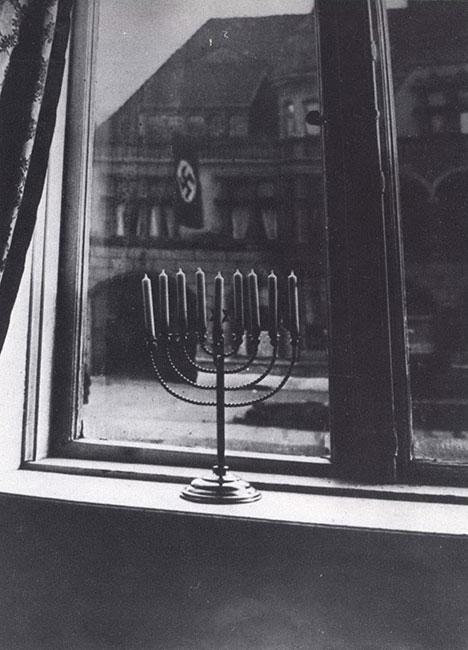
This symbolism did extend into the darkest times of Jewish history.
A striking example is the iconic photograph taken in Nazi Germany, showing a Hanukkiah lit on a windowsill,
with a Nazi flag visible in the background. Captured by Rachel Posner, the wife of Rabbi Akiva Posner.
The image became famous, being a powerful testament to Jewish defiance and hope during persecutions.
It stands as a reminder of Hanukkah’s enduring message that the light of faith and freedom can shine even
in the shadow of oppression.
Hanukkah Today: A Beacon of Faith and Resilience
Hanukkah is more than a historical commemoration. It is a testament to the strength of the Jewish spirit.
The flickering candles remind us of the light that defied darkness, the faith that triumphed over tyranny,
and the commitment to preserving Jewish identity and tradition against all odds.
In Israel, Hanukkah takes on a particularly profound significance. Streets glow with menorahs in windows,
children play dreidel games, and the nation celebrates the legacy of the Maccabees, who fought for Jewish
freedom in their ancient land, a fight that is not yet done.
As Jews continue to fight to live freely in the Jewish homeland, Hanukkah connects us to memories
of our past and our hope for the future.
Hanukkah lights in Nazi Germany.
Public image courtesy of Yad Vashem Holocaust Museum, Jerusalem.