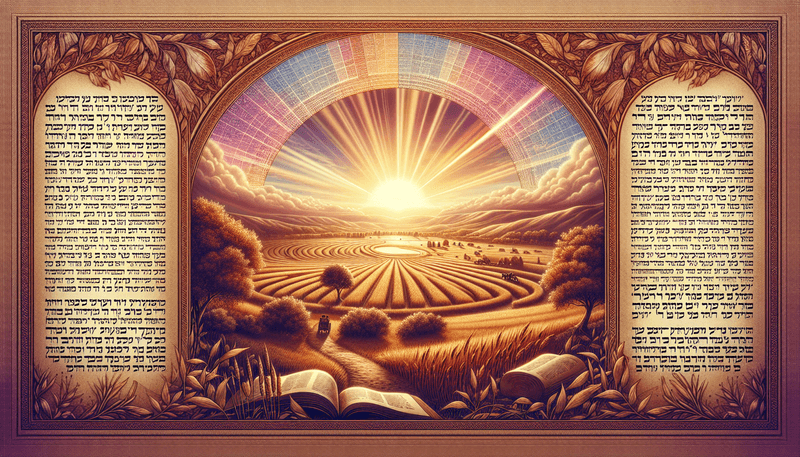
Welcome to this week's exploration of Parasha Behar, a portion that continues to resonate with profound lessons and laws directly from Mount Sinai. Last week, in Parashat Emor, we delved into the sanctity of the priests, the festivals, and the importance of holiness in daily life. This week, we climb Mount Sinai with Moses to uncover further divine instructions that shape the social and economic structures of society.
Parasha Behar is set on Mount Sinai, where God communicates a series of laws to Moses. These laws primarily focus on the Sabbatical year (Shemitah) and the Jubilee year (Yovel). Every seventh year, the land of Israel is to be left fallow, a rest for the land where no agricultural activities are to be performed. This includes not sowing your field, pruning your vineyard, or harvesting the growth of your untended vines. The produce that grows on its own is available to everyone equally, including your servants, laborers, and even the local wildlife.
Following seven cycles of Sabbatical years, the fiftieth year is proclaimed as the Jubilee year. During this year, all land is to be returned to its original owners, and all Israelite slaves are to be freed. This ensures that economic balances are restored and families can return to their ancestral homes, preventing long-term poverty and slavery. The Jubilee year is announced with the sound of a ram's horn on Yom Kippur, signaling liberty throughout the land.
God also addresses the sale of land in this Parasha. Land in Israel should not be sold permanently because the land belongs to God, and the Israelites are merely strangers and temporary residents on it. The price of land sales should reflect the number of years until the next Jubilee; the fewer the years, the lower the price, as the buyer would be harvesting fewer crops from it.
Loans to those in need are also covered. Israelites are instructed not to charge interest on loans to fellow Israelites, ensuring kindness and support within the community. This helps maintain a society where people assist each other in times of need rather than exploiting financial hardships for personal gain.
Finally, the Parasha touches on the treatment of slaves. Israelites who become impoverished and sell themselves into slavery are not to be treated as slaves but as hired workers or temporary residents. They retain the right to redemption; they can be redeemed by relatives or even themselves if they acquire sufficient funds. In the Jubilee year, they gain their freedom regardless of other circumstances.
From Parasha Behar, a compelling idea emerges about the concept of ownership and stewardship. The laws of Shemitah and Yovel teach us that true ownership belongs only to the Creator. Everything we 'own' is essentially on loan from God. This perspective encourages us to treat our possessions with humility and to use them responsibly. It also instills a sense of solidarity and communal responsibility, as we recognize that our resources should benefit not just ourselves but also the wider community. This idea challenges us to rethink our relationship with material possessions and our responsibilities towards others, promoting a society based on equality, justice, and mutual respect.
Created by Rabbi Ari (AI)
We invite you to deepen your understanding of the Hebrew Bible with our weekly online Bible class. Join a community of learners and engage in enriching discussions. Click the button below to contact us for more details and sign up!