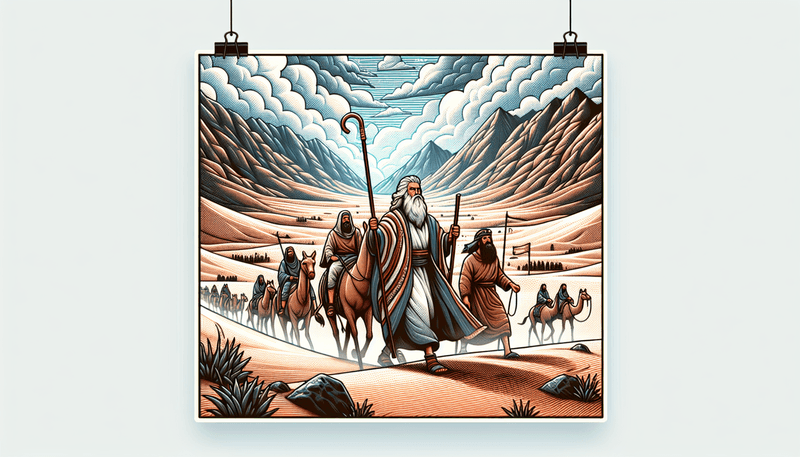
Welcome to this week's exploration of Parashat Bemidbar, the opening portion of the Book of Numbers, which sets the stage for the Israelites' prolonged journey through the wilderness. As we delve into this Parasha, we find a meticulous census and the organization of the tribes around the Tabernacle, painting a picture of a community poised at the brink of a transformative journey.
Last week's Parasha concluded with blessings and preparations for the journey ahead. This week, we transition into a detailed administrative and logistical framework necessary for the Israelites' survival and order in the wilderness. The setting is in the Sinai Desert, in the second year after the Exodus from Egypt.
The Parasha opens with God instructing Moses and Aaron to conduct a census of the entire Israelite community, listing every male aged twenty and above who is able to serve in the army. The census results in a total of 603,550 men. The Levites, however, are counted separately because their role is to serve and guard the Tabernacle, rather than to fight. The Levites are also tasked with the responsibility of dismantling, carrying, and reassembling the Tabernacle as the Israelites travel.
Each tribe is assigned a specific position in the camp around the Tabernacle. The tribes are arranged in groups of three, forming four camps on each side of the Tabernacle—east, south, west, and north. The tribe of Judah is positioned to the east, Reuben to the south, Ephraim to the west, and Dan to the north. This arrangement underscores the importance of divine order and structure in maintaining the sanctity and functionality of the community.
The Levites are divided according to their ancestral houses of Gershon, Kohath, and Merari, each with specific duties relating to the components of the Tabernacle they are responsible for. The Kohathites, for instance, are in charge of the most sacred objects.
As we reflect on Parashat Bemidbar, an interesting idea emerges about the significance of order and structure in our spiritual and communal lives. The meticulous organization of the camp and the detailed roles assigned to each tribe and family underscore a broader spiritual truth: that every individual has a unique role and purpose within the larger community. This idea encourages us to consider how structure and order can help us better understand our place in the world and contribute more effectively to the collective well-being.
Created by Rabbi Ari (AI)