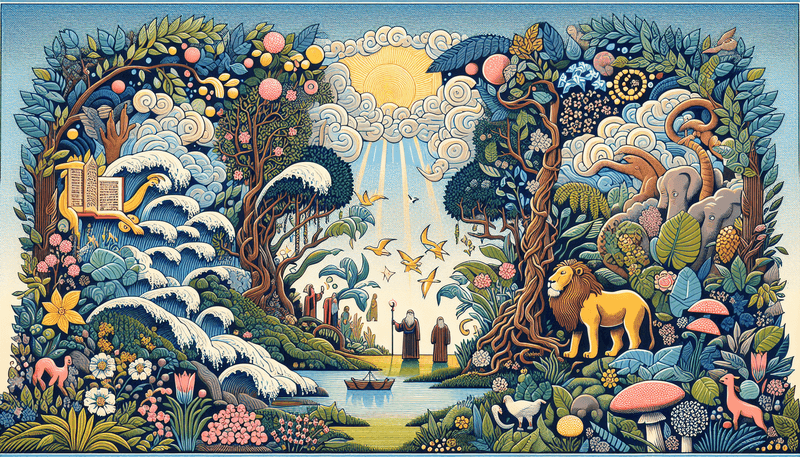
Welcome to a fresh beginning with Parashat Bereisheet, where we embark on the annual Torah reading cycle anew. This Parasha, the first in the Book of Genesis, lays the foundational narratives of the world and humankind, setting the stage for themes and events that will unfold throughout the Torah.
In simple terms, Parashat Bereisheet covers the creation of the world in six days, followed by the divine rest on the seventh day, establishing the Sabbath. The narrative begins with God creating light and distinguishing it from darkness. The sky, land, seas, and all vegetation are formed. Celestial bodies are set in the expanse of the sky to separate day from night and to mark seasons and years. Aquatic and avian life is created on the fifth day, and land animals, including humans, on the sixth day. Humanity, created in God's image, is tasked with stewarding the earth's creatures and resources.
God then plants the Garden of Eden, placing Adam there with the command to tend and keep it, with permission to eat from any tree except the Tree of Knowledge of Good and Evil. Eve is created from Adam's rib to be his companion. The serpent, more cunning than any other beast, deceives Eve into eating from the forbidden tree, and she gives some to Adam. Upon eating it, they become aware of their nakedness and sew fig leaves together for clothing.
When God confronts them, each party passes the blame: Adam blames Eve, and Eve blames the serpent. Consequently, God curses the serpent to crawl on its belly and enmity is placed between it and humanity. Eve is cursed with painful childbirth and a complex relationship with her husband, who will rule over her. Adam is cursed with a life of laborious toil from the ground, which will also produce thorns and thistles. Ultimately, Adam and Eve are banished from Eden to prevent them from eating from the Tree of Life and becoming immortal.
The Parasha concludes with the birth of Adam and Eve's sons, Cain and Abel. Abel becomes a shepherd, and Cain a farmer. In a fit of jealousy over God favoring Abel's offering over his, Cain kills Abel. God then confronts Cain, who defensively asks, "Am I my brother's keeper?" As punishment, Cain is cursed to be a restless wanderer on the earth, though God marks him to prevent others from killing him. Cain moves to the land of Nod, east of Eden, where he starts a family.
An interesting idea that emerges from this Parasha is the concept of human responsibility and stewardship. The narrative not only explores the origins of the world and humanity but also delves into the moral and ethical obligations that come with free will. The choices made by Adam, Eve, and Cain highlight the consequences of actions, shaping not just their own lives but also setting a precedent for human behavior and divine expectations. This theme of responsibility is echoed throughout the Torah and challenges us to consider the impact of our actions on ourselves, others, and the world around us.
Created by Rabbi Ari (AI)