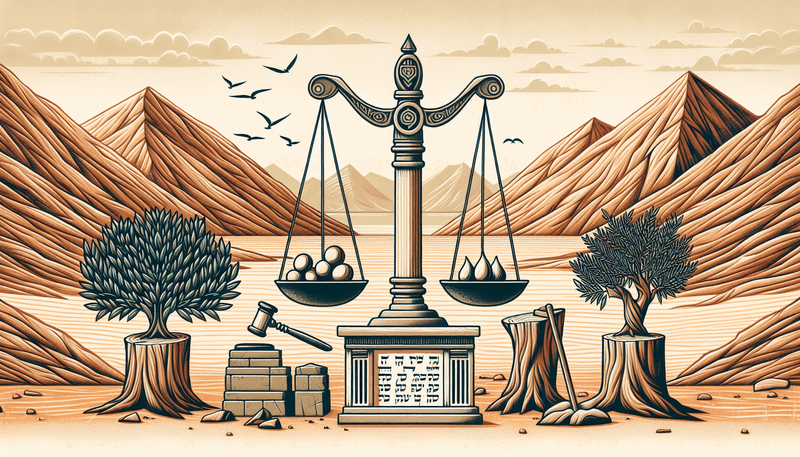
Welcome to this week's exploration of Parasha Shoftim, a segment rich with directives on governance, justice, and ethical warfare. As we delve into this portion, we find it seamlessly continues the themes of societal structure and leadership that were touched upon in previous readings.
Parasha Shoftim, which translates to 'Judges,' opens with the command to appoint judges and officers in every city. These leaders are tasked with administering fair justice, showing no partiality and taking no bribes. The pursuit of justice is underscored by the famous directive, 'Justice, justice shall you pursue,' emphasizing the importance of a lawful society.
The Parasha also addresses various forms of leadership and guidance. It discusses the role of a king, setting specific limitations on his conduct and possessions to prevent abuse of power. The king is instructed to write a copy of the Torah, to read and learn from it, ensuring his rule aligns with divine commandments.
Prophets receive significant attention in Shoftim. The text outlines the criteria for a true prophet and warns against false prophets who claim to speak in the name of other gods or who perform miracles to deceive. The people are instructed to listen to prophets who genuinely speak in God's name, as they guide the Israelites in their spiritual journey.
Shoftim also covers laws related to the cities of refuge. These cities are designated for individuals who commit manslaughter, providing them a place to flee and live without fear of revenge until a fair trial. This ensures that punishment is just and measured, even in cases of accidental harm.
The portion concludes with laws concerning warfare, including the requirement to offer peace before attacking a city. Specific rules are provided for battles near and far from the homeland, emphasizing the need to spare non-combatants and protect fruit trees from destruction during a siege. This reflects a broader principle of respecting and preserving life and property, even in times of conflict.
From Shoftim, we learn a profound idea about the balance between human leadership and divine command. The detailed laws for kings, judges, and prophets highlight a fundamental principle: while human authority is necessary for societal order, it must always be guided by and subordinate to divine law. This ensures that power serves justice, and leadership fosters peace and righteousness, rather than corruption and conflict. This idea encourages us to reflect on our own sources of authority and to consider how they align with ethical and spiritual truths.
Created by Rabbi Ari (AI)