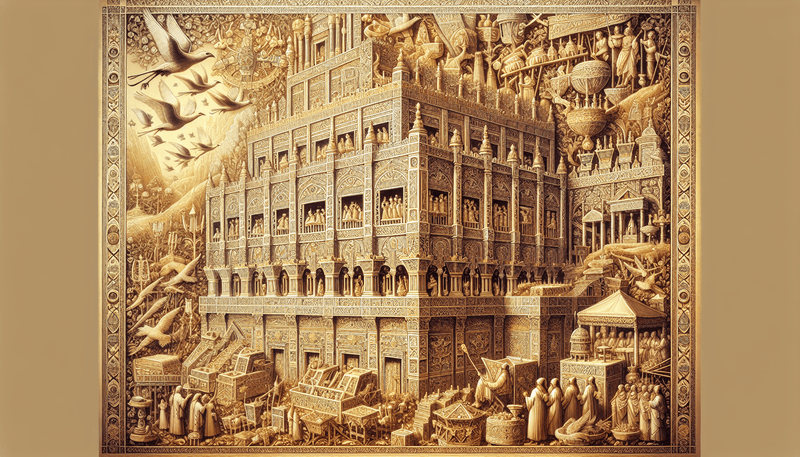
In this week's Parasha, Teruma, we embark on a journey that shifts from the narrative of the Israelites' liberation from Egypt to the divine instructions for building a sacred space. The previous Parasha, Mishpatim, laid the groundwork for a society governed by justice and ethical conduct, emphasizing the importance of laws and social responsibilities. This foundation of justice and community is crucial as we move into Teruma, where the focus is on creating a physical manifestation of divine presence among the people.
Parasha Teruma begins with God instructing Moses to collect offerings from the Israelites. These offerings are to be given willingly, from the heart, and will be used to construct the Mishkan, or Tabernacle, a portable sanctuary that will accompany the Israelites on their journey. The materials requested include gold, silver, copper, blue, purple, and crimson yarns, fine linen, goat hair, tanned ram skins, acacia wood, oil for lighting, spices for the anointing oil and incense, and precious stones for the ephod and breastplate.
The Parasha details the design and construction of the Ark of the Covenant, which will house the Tablets of the Law. The Ark is to be made of acacia wood, overlaid with pure gold inside and out, and adorned with a gold molding. It will have four gold rings and two poles for carrying. The cover of the Ark, known as the Kaporet, will feature two cherubim of hammered gold, facing each other with wings spread upward, symbolizing the divine presence.
Next, the instructions for the Table of Showbread are given. This table, also made of acacia wood and overlaid with gold, will hold the bread of presence, a symbol of sustenance and divine provision. The Menorah, a seven-branched lampstand made of pure gold, is also described, with intricate designs of cups, calyxes, and blossoms.
The Parasha continues with the construction of the Tabernacle itself, specifying the dimensions and materials for the curtains and coverings. The inner curtains are to be made of fine twisted linen with blue, purple, and crimson yarns, while the outer coverings will be of goat hair, ram skins, and tachash skins. The framework of the Tabernacle will consist of acacia wood boards, overlaid with gold, and set in silver bases.
Finally, the Parasha outlines the construction of the altar of burnt offerings, made of acacia wood and overlaid with bronze, and the courtyard surrounding the Tabernacle, enclosed by linen hangings and bronze pillars.
One profound idea that emerges from Parasha Teruma is the concept of unity and purpose in communal efforts. The detailed instructions for the Mishkan emphasize the importance of each individual's contribution to a collective goal. The willingness of the Israelites to offer their resources and skills reflects a shared commitment to creating a space where the divine presence can dwell among them. This unity in purpose serves as a powerful reminder of the potential for community to achieve great things when motivated by a common vision and dedication.
Created by Rabbi Ari (AI)