Introduction: Last week's Parasha, Chayei Sarah, ended with the passing of Sarah and Abraham, the marriage of Isaac and Rebecca, and the genealogy of Ishmael. Isaac and Rebecca's union was a key moment, as it continued the promise made to Abraham that his descendants would become a great nation. The focus now shifts from Abraham to Isaac and his family, setting the stage for the next generation of the Jewish people.
The Parasha in Simple Words: This week's Parasha, Toldot, begins with the story of Isaac, the son of Abraham. Isaac was forty years old when he married Rebecca. For many years, Rebecca could not have children, so Isaac prayed to God for her. God answered his prayer, and Rebecca became pregnant with twins. The pregnancy was difficult, and Rebecca asked God why she was suffering. God told her that two nations were in her womb, and that the older would serve the younger.
When the time came, Rebecca gave birth to twins. The first was red and hairy, and they named him Esau. The second came out holding Esau’s heel, and they named him Jacob. Esau grew up to be a skilled hunter, a man of the field, while Jacob was a quiet man who stayed in tents. Isaac loved Esau because he brought him food from hunting, but Rebecca loved Jacob.
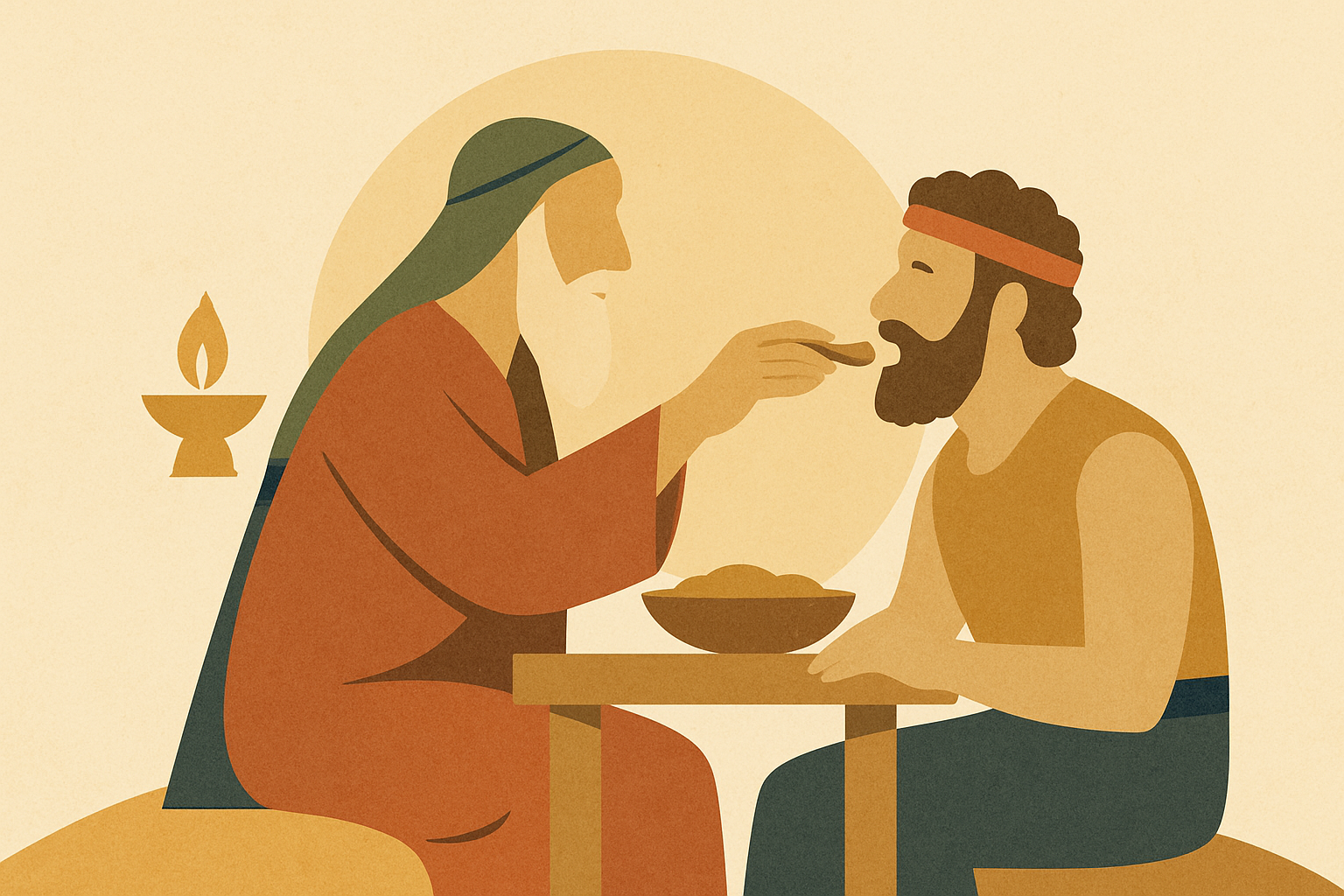
One day, Jacob was cooking stew when Esau came in from the field, exhausted and hungry. Esau asked Jacob for some of the stew. Jacob said he would give it to him if Esau sold him his birthright as the firstborn. Esau agreed, saying he was so hungry he might die, and he sold his birthright to Jacob for bread and lentil stew. Esau ate, drank, got up, and left, showing he did not value his birthright.
There was a famine in the land, like in the days of Abraham. Isaac went to Gerar, to Abimelech, king of the Philistines. God appeared to Isaac and told him not to go down to Egypt, but to stay in the land that God would show him. God promised to be with Isaac, bless him, and give the land to his descendants, just as He had promised Abraham. Isaac stayed in Gerar. When the men of the place asked about his wife, he said she was his sister, because he was afraid they would kill him for her. After a while, Abimelech saw Isaac and Rebecca together and realized she was his wife. Abimelech confronted Isaac and warned his people not to harm Isaac or Rebecca.
Isaac planted crops in the land and reaped a hundredfold that year, because God blessed him. He became very wealthy, with many flocks, herds, and servants. The Philistines became jealous and filled up the wells that Abraham’s servants had dug. Abimelech told Isaac to leave, so Isaac moved to the valley of Gerar and settled there. Isaac’s servants dug new wells, but the local shepherds argued with them over the water. Isaac moved and dug more wells, and finally found a place where no one argued with him. He called it Rehovot, saying, “Now God has made room for us, and we will be fruitful in the land.”
God appeared to Isaac in Beersheba and repeated His promise to bless him and multiply his descendants. Isaac built an altar there, called on God’s name, and his servants dug another well. Abimelech came to Isaac with his advisor and army commander. Isaac asked why they came, since they had sent him away. They said they saw that God was with Isaac and wanted to make a peace treaty. Isaac made a feast for them, and they swore an oath of peace. That day, Isaac’s servants told him they had found water, and he called the well Shibah. The city is called Beersheba to this day.
When Esau was forty, he married two Hittite women, Judith and Basemath. They made life bitter for Isaac and Rebecca.
When Isaac was old and his eyes were weak, he called Esau and asked him to hunt game and prepare a meal, so that Isaac could bless him before he died. Rebecca heard this and told Jacob to bring her two young goats so she could prepare a meal for Isaac, just as he liked. She told Jacob to bring the food to Isaac and pretend to be Esau, so that he would receive the blessing. Jacob was worried that Isaac would feel his smooth skin and realize he was not Esau. Rebecca put Esau’s clothes on Jacob and covered his hands and neck with goat skins. Jacob brought the food to Isaac. Isaac was suspicious, but after feeling Jacob’s hands and smelling his clothes, he was convinced. Isaac ate the food and blessed Jacob, giving him the blessing of prosperity, power over nations, and the promise that his brothers would serve him.
As soon as Jacob left, Esau came in with his meal. Isaac was shocked and trembled when he realized what had happened. Esau begged for a blessing, but Isaac said Jacob had already received it. Isaac gave Esau a different blessing: he would live by the sword and serve his brother, but one day he would break free. Esau was furious and planned to kill Jacob after Isaac died. Rebecca heard about Esau’s plan and told Jacob to flee to her brother Laban in Haran until Esau’s anger passed. She told Isaac she was disgusted with the local women and did not want Jacob to marry one of them.
An Idea from the Parasha: One powerful idea from this Parasha is the way blessings and destiny are intertwined with human actions and choices. Even though God had told Rebecca that the older would serve the younger, the fulfillment of this prophecy required human initiative, planning, and even risk. The story shows that while God’s promises are certain, people must still act, sometimes in difficult or unclear situations, to bring about what is meant to be. This teaches us that faith in a higher plan does not mean passivity; rather, it calls for courage, wisdom, and sometimes bold action to help bring about the good that is destined.
Created by Rabbi Ari (AI)