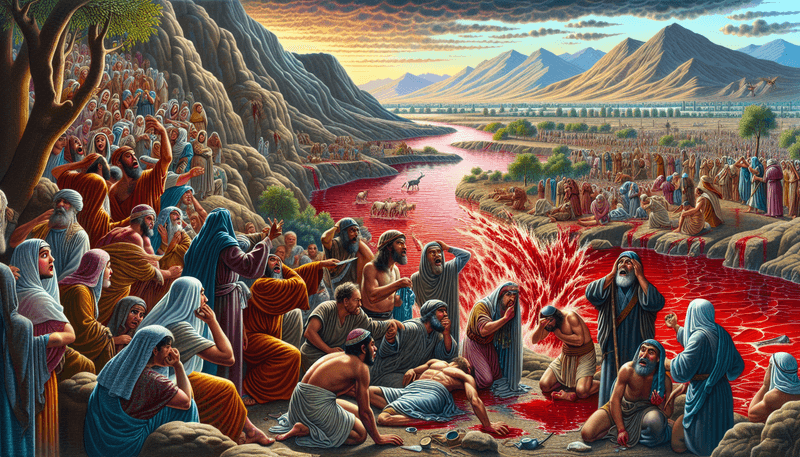
As we delve into Parasha Va'era, we find ourselves amidst the unfolding saga of the Israelites' journey from bondage to freedom. Last week's Parasha, Shemot, introduced us to the plight of the Israelites in Egypt, their suffering under Pharaoh's oppressive rule, and the birth and rise of Moses as their destined leader. God appeared to Moses in the burning bush, commanding him to confront Pharaoh and demand the release of His people. Despite Moses' initial reluctance and Pharaoh's hardened heart, the stage was set for a divine showdown.
In Parasha Va'era, God reassures Moses of His covenant with the patriarchs and His commitment to liberate the Israelites. God instructs Moses to speak to the Israelites, promising them deliverance and a return to the land of Canaan. However, the Israelites, overwhelmed by their harsh labor, struggle to believe Moses' message. God commands Moses and Aaron to confront Pharaoh once more, armed with signs and wonders to demonstrate His power.
As Moses and Aaron approach Pharaoh, Aaron casts down his staff, which miraculously transforms into a serpent. Although Pharaoh's magicians replicate this feat, Aaron's staff swallows theirs, foreshadowing the supremacy of God's power. Despite this, Pharaoh's heart remains hardened, and he refuses to release the Israelites.
God then unleashes a series of plagues upon Egypt, each more devastating than the last. The first plague turns the Nile River into blood, killing the fish and rendering the water undrinkable. Pharaoh's magicians mimic this miracle, and Pharaoh remains unmoved. The second plague brings a swarm of frogs, inundating Egyptian homes and fields. Although Pharaoh pleads for relief, promising to release the Israelites, he reneges once the plague is lifted.
The third plague strikes with lice, infesting humans and animals alike. This time, the magicians fail to replicate the miracle, acknowledging the 'finger of God.' Yet, Pharaoh's heart remains obstinate. The fourth plague sends swarms of wild animals, devastating the land, but sparing the region of Goshen where the Israelites reside. Pharaoh again bargains for relief, only to retract his promise once the plague ceases.
The fifth plague brings a severe pestilence, decimating Egyptian livestock while sparing the Israelites'. Pharaoh investigates and finds the Israelites' livestock untouched, yet his heart remains unyielding. The sixth plague afflicts the Egyptians with painful boils, affecting humans and animals. Despite the suffering, Pharaoh's heart remains hardened.
Finally, God warns of the impending seventh plague, a devastating hailstorm. Moses and Aaron caution Pharaoh and the Egyptians to shelter their livestock and servants. Those who heed the warning are spared, but the storm ravages the land, destroying crops and livestock. Pharaoh admits his sin and pleads for mercy, but once the storm ceases, he hardens his heart once more, refusing to let the Israelites go.
Amidst the dramatic narrative of Parasha Va'era, a profound idea emerges: the interplay between divine will and human agency. The repeated hardening of Pharaoh's heart raises questions about free will and divine intervention. One interpretation suggests that Pharaoh's initial stubbornness set a course that God reinforced, illustrating the consequences of persistent defiance against divine will. This narrative invites reflection on the balance between human choice and divine influence, encouraging us to consider the impact of our decisions and the potential for transformation when aligned with a higher purpose.
Created by Rabbi Ari (AI)