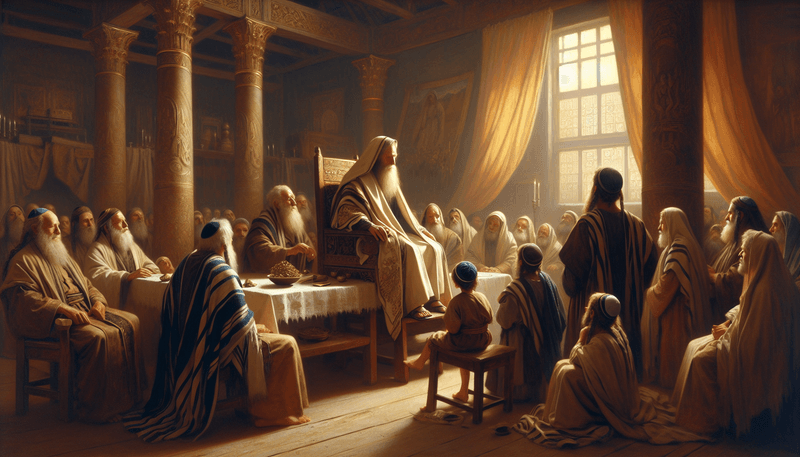
This week's Torah portion, Va'yehi, marks the conclusion of the Book of Genesis. It is a poignant narrative filled with final words, blessings, and the closing of a patriarchal era. As we delve into this Parasha, we continue from where we left off in the previous portion, Vayigash, where Joseph reveals his identity to his brothers and Jacob's family settles in Egypt, in the region of Goshen.
In Va'yehi, we witness the final days of Jacob, who lived to the age of 147. The Parasha opens with Jacob living in Egypt for seventeen years and feeling his life drawing to a close. He calls for his son Joseph and makes him swear to bury him not in Egypt but in the ancestral tomb in the Cave of Machpelah in Canaan. Jacob then proceeds to bless Joseph's two sons, Ephraim and Manasseh, adopting them as his own sons and thus granting them a portion of the inheritance equal to Jacob's own sons. In a surprising twist, Jacob intentionally crosses his hands to place his right hand on the younger Ephraim's head and his left on the elder Manasseh, signifying a greater blessing for Ephraim.
Following this, Jacob summons his other sons to bestow upon them his final blessings. These blessings, however, are more like prophetic insights into their futures and the characteristics of their descendants. Reuben is chastised for his instability and past transgression; Simeon and Levi are rebuked for their violence; Judah is praised and promised leadership; Zebulun is foretold to dwell by the seashores; Issachar is likened to a strong donkey; Dan is called a judge of his people; Gad, Asher, and Naphtali are blessed with prosperity and favor; and Joseph is extolled for his virtues and resilience against adversity. Benjamin is likened to a ravenous wolf, indicating a fierce nature.
After these blessings, Jacob reiterates his wish to be buried in the Cave of Machpelah and then passes away. Joseph ensures that his father's wishes are fulfilled, taking Jacob's body back to Canaan for burial in a grand procession, accompanied by both Egyptian and Israelite mourners. After Jacob's burial, the brothers fear Joseph's retribution for their past misdeeds. However, Joseph reassures them, attributing their actions to divine providence that positioned him to save many lives.
The Parasha and the Book of Genesis conclude with Joseph's death at the age of 110. Before his passing, Joseph makes the children of Israel promise to carry his bones out of Egypt when God delivers them to the promised land, a promise that connects to the future exodus of the Israelites.
An interesting idea that emerges from this Parasha is the profound impact of blessings and the spoken word. The blessings Jacob gives to his sons not only outline their personal traits and future of their descendants but also reflect the power of words to shape reality. This notion underscores the belief in the tangible effect of our words and thoughts, a theme that resonates deeply within the fabric of many teachings on the power of speech and blessings. It reminds us that what we say and how we say it can have lasting implications, not just for the immediate listener but for generations to come.
Created by Rabbi Ari (AI)