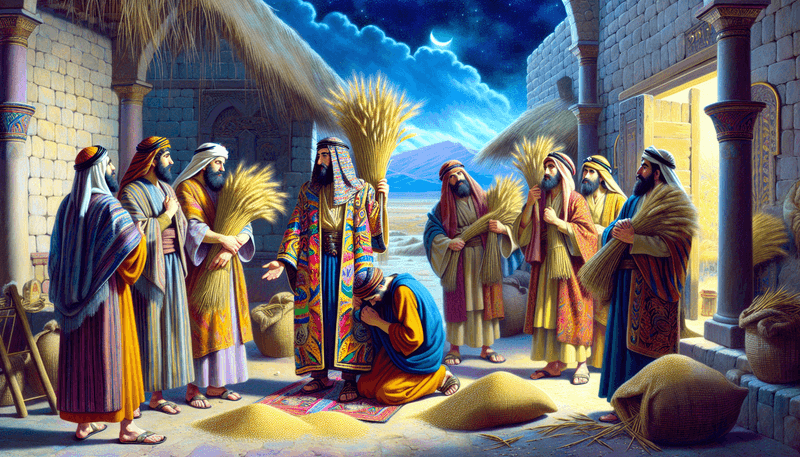
Welcome to this week's exploration of Parashat Va'yeshev, a portion rich with drama and deep lessons. Last week, in Parashat Vayishlach, we witnessed Jacob's intense encounters from wrestling with an angel to reconciling with his brother Esau. These events set the stage for the focus to shift towards Jacob's children, particularly Joseph, whose story dominates the narrative of Va'yeshev.
In simple terms, Parashat Va'yeshev, which means 'And he settled,' dives into the complexities of Joseph's life, beginning with his father Jacob's favoritism towards him, symbolized by a special multi-colored coat. This favoritism stirs envy and hatred among his brothers. Joseph, not helping his case, shares two of his dreams which imply that he is destined to rule over his family, further fueling their resentment.
The brothers' jealousy reaches a boiling point, leading them to conspire against him. Initially, they plan to kill Joseph but end up selling him into slavery to a caravan of Ishmaelites heading to Egypt. To cover their tracks, they dip Joseph's coat in goat's blood and deceive their father Jacob into believing that a wild animal has devoured his beloved son. Meanwhile, Joseph is sold to Potiphar, an officer of Pharaoh in Egypt.
The narrative then briefly shifts to Judah, another son of Jacob, who faces his own set of challenges. Judah marries and has three sons. His first son, Er, marries Tamar but dies because of his wickedness, as does his second son, Onan, leaving Tamar widowed and childless. In a twist of cultural duty, Tamar deceives Judah into fathering her children, leading to the birth of twins Perez and Zerah.
Back in Egypt, Joseph rises to become the overseer of Potiphar's house. However, his success is short-lived as he faces false accusations from Potiphar's wife, leading to his imprisonment. Even in jail, Joseph's leadership qualities shine through, and he is placed in charge of all the prisoners. The parasha concludes with Joseph interpreting the dreams of Pharaoh's cupbearer and baker, hinting at his future role in Egypt.
From Parashat Va'yeshev, we can extract a profound idea about the nature of challenges and destiny. The narrative shows that personal trials, whether they be envy from others, betrayal, or false accusations, are not merely obstacles. Instead, they are integral to the unfolding of one's destiny. Joseph's journey from the pit to the prison, and eventually to a position of power, illustrates how adversities are often the path to fulfilling one's purpose. This perspective encourages resilience and faith, suggesting that the trials we face may be preparing us for our roles in the world, just as they prepared Joseph for his.
Created by Rabbi Ari (AI)