Last week, in Parashat Chukat, the Israelites continued their journey through the wilderness. We saw the passing of Miriam and Aaron, the incident with the rock where Moses struck instead of speaking, and the people’s complaints about water and food. The Israelites faced opposition from Edom, Arad, Sihon, and Og, but ultimately defeated these kings and camped on the plains of Moab, right across from Jericho. This is where our story picks up in Parashat Balak.
As the Israelites camped near Moab, Balak, the king of Moab, saw what they had done to the Amorites and became very afraid. He sent messengers to Balaam, a well-known prophet living in Pethor, asking him to come and curse the Israelites, hoping this would help him defeat them. The messengers brought gifts, but God appeared to Balaam and told him not to go with them and not to curse the Israelites, because they are blessed. Balaam sent the messengers away. Balak sent more important messengers with even greater promises, but Balaam told them he could only do what God allowed. That night, God told Balaam that if the men came to call him, he could go with them, but only do what God told him. In the morning, Balaam saddled his donkey and went with the princes of Moab.
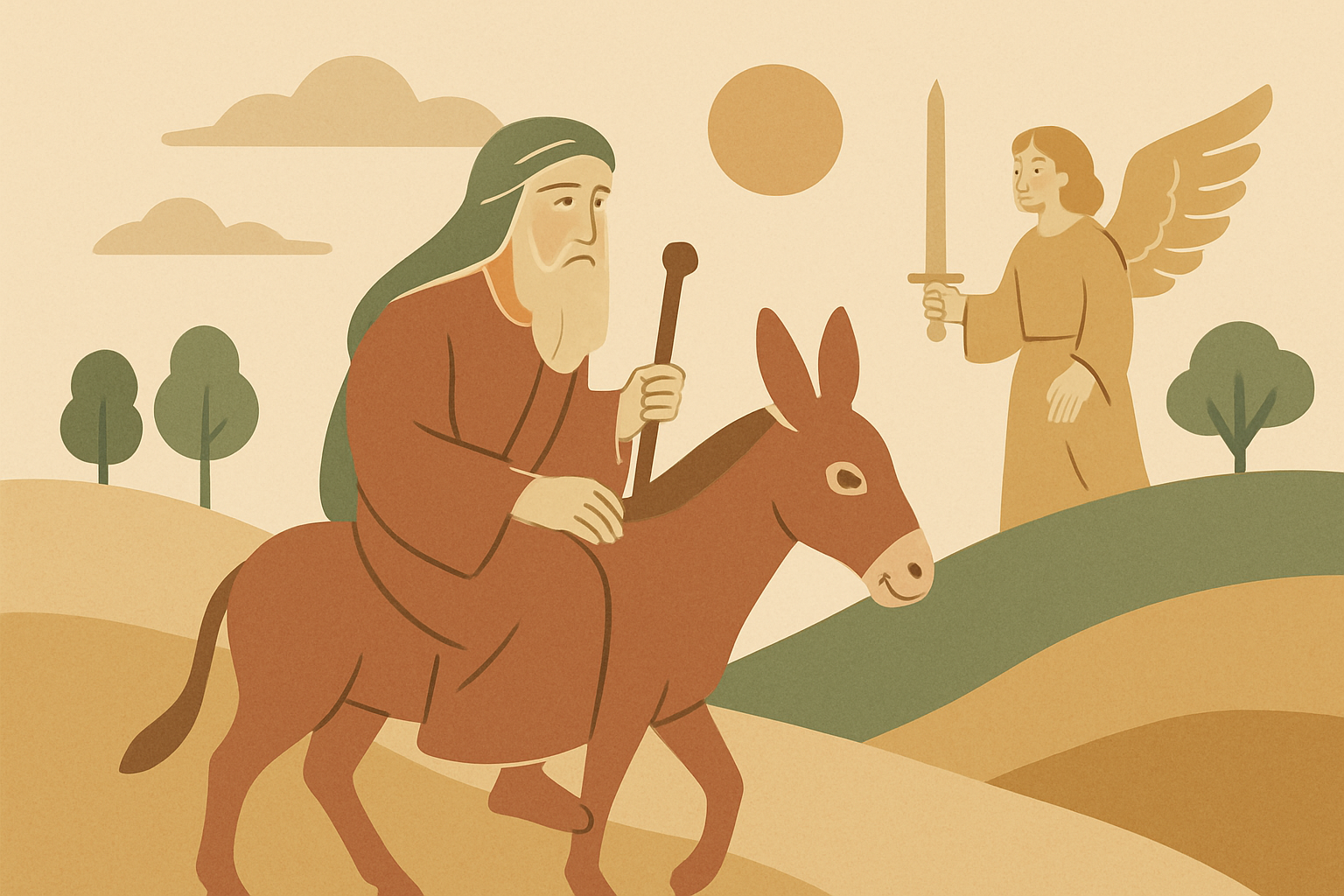
God was angry that Balaam went, and sent an angel to block his way. Balaam’s donkey saw the angel and turned off the road. Balaam hit the donkey to get her back on the path. This happened three times: the donkey saw the angel and tried to avoid it, and each time Balaam struck her. Then God opened the donkey’s mouth, and she asked Balaam why he was hitting her. Balaam answered that she was making a fool of him. God then opened Balaam’s eyes, and he saw the angel standing in the way with a sword. The angel told Balaam that the donkey saved his life by turning aside. Balaam admitted his mistake, and the angel told him to continue, but only say what God told him.
Balaam arrived in Moab, and Balak took him to the high places of Baal to see part of the Israelite camp. Balaam told Balak to build seven altars and offer a bull and a ram on each. Balaam went aside, and God put words in his mouth. Instead of a curse, Balaam blessed the Israelites, saying they are a people set apart and will be as numerous as the dust. Balak was upset, but Balaam said he could only say what God told him. Balak took Balaam to another place, the field of Zophim, hoping he could curse them from there. Again, seven altars were built, and sacrifices offered. Again, Balaam blessed the Israelites, saying God does not change His mind, and there is no magic against Israel. Balak was frustrated, but tried a third place, the top of Peor. The same process happened: seven altars, sacrifices, and Balaam blessed Israel again, saying how beautiful their tents are, and that they will be strong and victorious. Balak was angry and told Balaam to go home, but Balaam reminded him he could only speak God’s words.
Before leaving, Balaam gave a final prophecy about what would happen in the future. He said a star would come from Jacob, a ruler would rise from Israel, and he would defeat Moab and other nations. He also spoke about the fate of Amalek, the Kenites, and others, saying they would be destroyed. After this, Balaam and Balak went their separate ways.
While Israel was camped at Shittim, the people began to have relations with Moabite women, who invited them to their sacrifices to their gods. The Israelites ate and bowed to these gods, especially Baal Peor. God became angry and told Moses to punish the leaders. A plague broke out among the people. An Israelite man brought a Midianite woman into his family in front of everyone, including Moses. Pinchas, the son of Eleazar the priest, saw this, took a spear, and killed both the man and the woman. The plague stopped, but 24,000 people had died.
One powerful idea from this Parasha is the way blessings and curses are not always in human control. Even when someone tries to use spiritual power for harm, as Balak did by hiring Balaam, the ultimate outcome is determined by a higher will. Sometimes, what seems like a curse can turn into a blessing, and the words meant to harm can become words of praise and hope. This teaches us that our intentions and actions matter, but there is a greater plan at work, and sometimes the very things we fear can become sources of strength and blessing.
Created by Rabbi Ari (AI)