Last week in Parashat Tetzaveh, we learned about the detailed instructions for the garments of the priests and the process of inaugurating Aaron and his sons as kohanim. The Parasha also described the daily offerings and the construction of the golden altar for incense. All of these instructions were given while Moses was still on Mount Sinai, receiving the laws and commandments directly from God. This context is crucial, as this week’s Parasha, Ki Tisa, picks up with Moses still atop the mountain, and the people waiting below.
In Parashat Ki Tisa, God commands Moses to take a census of the Israelites. Each person must give a half-shekel as an offering to God, which will be used for the service of the Tent of Meeting and as a way to atone for their lives. God then gives instructions for making a special copper basin for the priests to wash their hands and feet before serving, and for preparing the anointing oil and the incense, with precise recipes and warnings that these mixtures are holy and must not be used for any other purpose. God appoints Bezalel and Oholiab as the chief artisans to build the Mishkan (Tabernacle) and its vessels, and reminds the people to keep the Sabbath as a sign of the covenant between God and Israel.
While Moses is on the mountain for forty days and nights, the people grow anxious. They gather around Aaron and ask him to make a god to lead them, since they do not know what has happened to Moses. Aaron tells them to bring their gold jewelry, which he melts down and forms into a golden calf. The people declare, "This is your god, Israel, who brought you out of Egypt," and they offer sacrifices and celebrate.
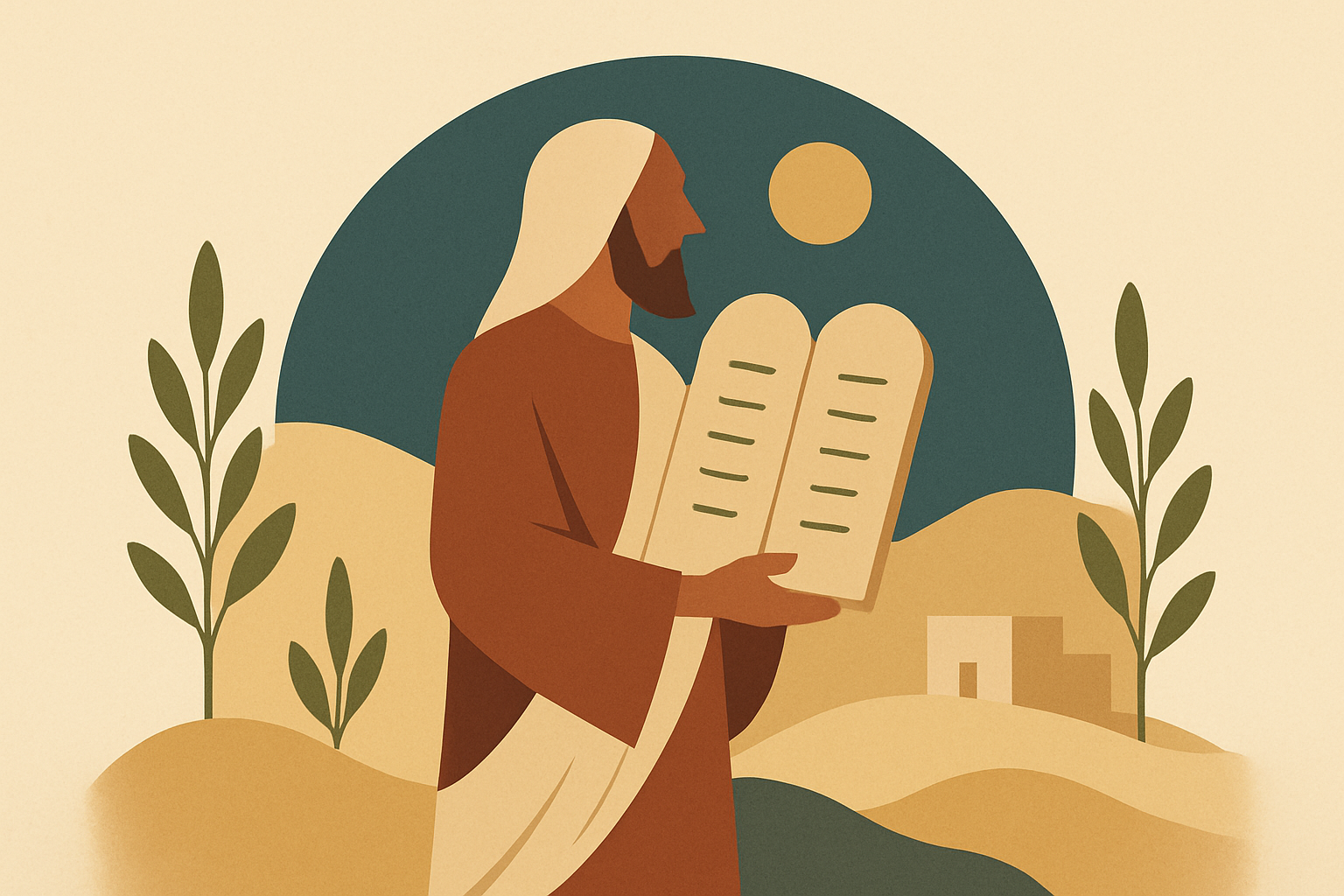
God tells Moses to go down immediately, because the people have corrupted themselves. God says He will destroy them and make a new nation from Moses, but Moses pleads for mercy, reminding God of His promises to Abraham, Isaac, and Jacob. God relents from destroying the people. Moses descends the mountain carrying the two tablets of the covenant. When he sees the calf and the dancing, he throws down the tablets and shatters them at the foot of the mountain. He burns the calf, grinds it to powder, scatters it on water, and makes the Israelites drink it. Moses confronts Aaron, who explains that the people pressured him and that the calf emerged from the fire.
Moses stands at the gate of the camp and calls out, "Whoever is for God, come to me!" The Levites gather to him, and at Moses’ command, they kill about three thousand men who were involved in the sin. The next day, Moses returns to God to plead for forgiveness, even offering his own life in place of the people. God says that those who sinned will be punished, but He will continue to lead the people. A plague strikes the people because of the calf.
God tells Moses to lead the people to the Promised Land, but says He will not go among them, lest He destroy them on the way. The people mourn, and Moses pitches his tent outside the camp, where he speaks to God "face to face." Moses asks God to continue to be present with the people and to show him His ways. God agrees, and Moses asks to see God's glory. God says that no one can see His face and live, but He will show Moses His goodness and proclaim His name. God places Moses in a cleft of the rock, covers him with His hand, and allows him to see His back as He passes by.
God tells Moses to carve two new tablets, and Moses ascends the mountain again. God descends in a cloud and proclaims His thirteen attributes of mercy: compassionate, gracious, slow to anger, abundant in kindness and truth, forgiving iniquity, transgression, and sin, but not clearing the guilty without consequence. Moses bows and asks God to forgive the people and take them as His own. God renews the covenant, promising to do wonders and drive out the nations from the land, but warns the people not to make covenants with the inhabitants or worship their gods. God repeats laws about the festivals, the firstborn, the Sabbath, and the prohibition against boiling a kid in its mother’s milk. Moses stays on the mountain for another forty days and nights, without eating or drinking, and writes the words of the covenant on the new tablets.
When Moses descends, his face is shining from speaking with God, and the people are afraid to approach him. Moses calls them, gives them the commandments, and then covers his face with a veil, removing it only when he speaks with God or teaches the people.
One of the most powerful ideas in this Parasha is the concept of forgiveness and the possibility of renewal after failure. Even after the grave sin of the golden calf, God allows the people to repent and gives them a second chance. The breaking of the first tablets and the giving of the second set symbolize that even when something precious is shattered, it is possible to rebuild and restore the relationship. This teaches us that no matter how serious a mistake may be, sincere repentance and a willingness to change can open the door to forgiveness and a new beginning. The Parasha reminds us that God’s mercy is greater than His anger, and that the path to return is always open.
Created by Rabbi Ari (AI)