Introduction: Last week, in Parashat Vayechi, we concluded the Book of Genesis with the passing of Jacob and Joseph. The family of Jacob, seventy souls in total, had settled in Egypt, enjoying a period of favor and prosperity thanks to Joseph’s high position. Before his death, Joseph made his brothers promise to carry his bones out of Egypt when God would eventually redeem them. The stage was set for the next chapter in the story of the Israelites, as a new era begins in Egypt.
The Parasha in Simple Words: This week’s Parasha, Shemot, opens with a list of the sons of Israel who came to Egypt with Jacob. The entire generation passes away, but their descendants multiply greatly and fill the land. A new Pharaoh arises who does not know Joseph. Seeing the Israelites’ growing numbers, he fears they might join Egypt’s enemies in war. To control them, he enslaves the Israelites, forcing them into hard labor building the cities of Pithom and Raamses. Despite the oppression, the Israelites continue to multiply.
Pharaoh then commands the Hebrew midwives, Shifrah and Puah, to kill all newborn Hebrew boys, but they fear God and let the boys live. When Pharaoh questions them, they explain that the Hebrew women give birth before the midwives arrive. God rewards the midwives with families of their own. Pharaoh then orders all his people to throw every newborn Hebrew boy into the Nile, but to let the girls live.
A man from the tribe of Levi marries a Levite woman, and they have a son. Seeing he is special, his mother hides him for three months. When she can no longer hide him, she places him in a basket among the reeds of the Nile. His sister stands nearby to watch. Pharaoh’s daughter comes to bathe in the river, sees the basket, and sends her maid to fetch it. She opens it, sees the crying baby, and has compassion, realizing he is a Hebrew child. The baby’s sister offers to find a Hebrew nurse, and brings the child’s mother, who nurses him. When the child grows, he is brought to Pharaoh’s daughter, who names him Moses, saying, “I drew him out of the water.”
When Moses grows up, he goes out to his brethren and sees their suffering. He sees an Egyptian beating a Hebrew and, after looking around, kills the Egyptian and hides him in the sand. The next day, he sees two Hebrews fighting and tries to intervene. One of them challenges Moses, asking if he intends to kill him as he did the Egyptian. Realizing his deed is known, Moses flees to Midian, as Pharaoh seeks to kill him.
In Midian, Moses sits by a well. The seven daughters of the priest of Midian come to draw water, but shepherds drive them away. Moses helps them and waters their flock. The girls return home early, and their father, Reuel (also called Jethro), invites Moses to stay and gives him his daughter Zipporah as a wife. She bears a son, Gershom, for Moses says, “I have been a stranger in a foreign land.”
Meanwhile, the king of Egypt dies, but the Israelites continue to groan under slavery and cry out. God hears their cries, remembers His covenant with Abraham, Isaac, and Jacob, and takes notice of them.
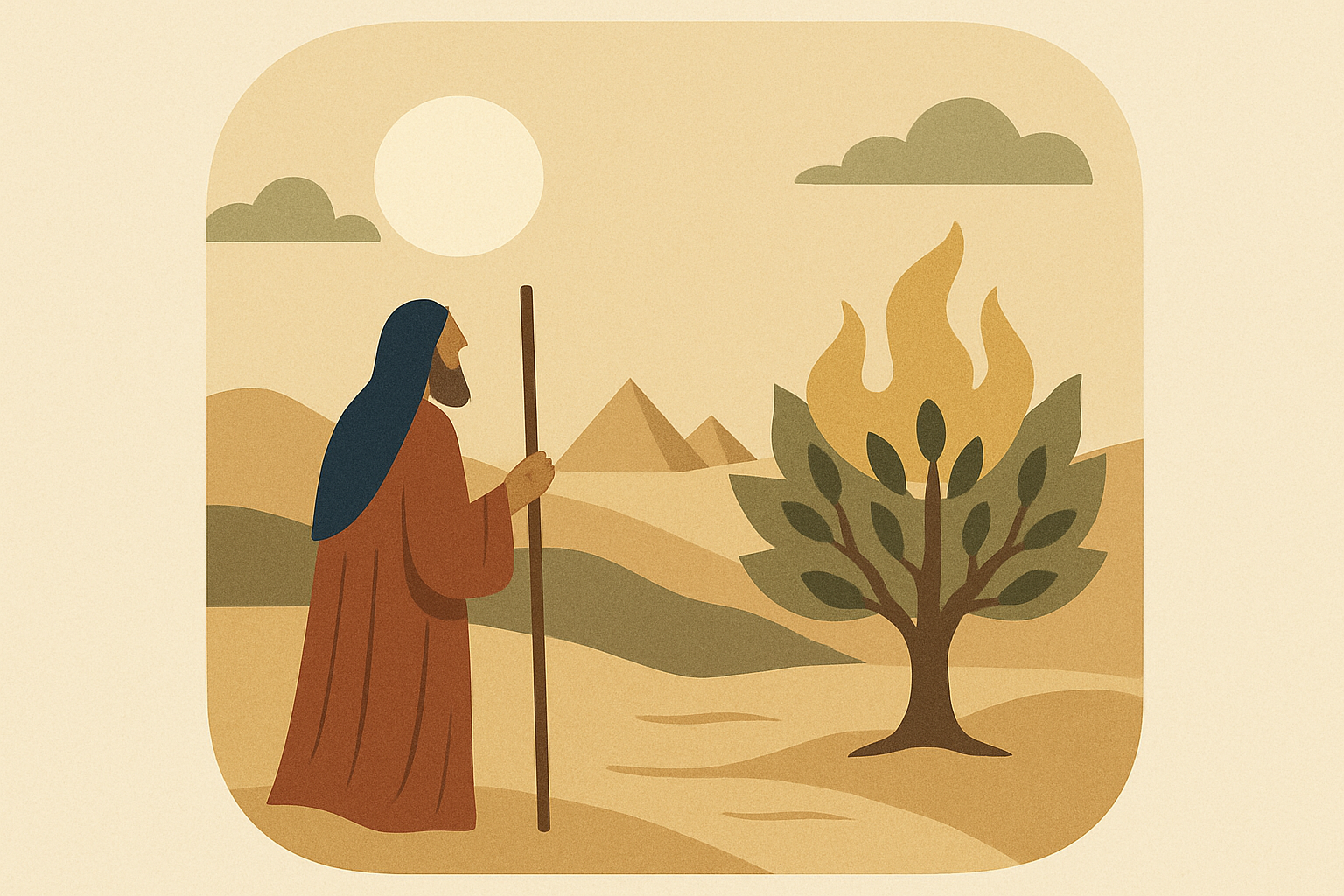
While tending Jethro’s flock near Mount Horeb, Moses sees a bush that burns with fire but is not consumed. God calls to him from the bush, telling him to remove his sandals, for the ground is holy. God reveals Himself as the God of Moses’ ancestors and tells Moses He has seen the suffering of His people and will deliver them from Egypt to a good and spacious land. God appoints Moses to go to Pharaoh and lead the Israelites out of Egypt. Moses protests, questioning his worthiness and how the people will believe him. God tells Moses to say, “I Am Who I Am” has sent him, and to tell the elders that God will bring them out of Egypt. God instructs Moses that the elders should go with him to Pharaoh and request a three-day journey to sacrifice to God. God warns that Pharaoh will not let them go easily, but He will strike Egypt with wonders, after which Pharaoh will let them go. The Israelites will leave with silver, gold, and clothing from their Egyptian neighbors.
Moses worries that the people will not believe him. God gives him three signs: turning his staff into a snake, making his hand leprous and then healed, and turning water from the Nile into blood. Moses still protests, saying he is not a man of words. God reassures him, saying He will be with him, but Moses asks God to send someone else. God becomes angry but tells Moses that his brother Aaron will speak for him, and Moses will perform the signs. Moses returns to Jethro, asks permission to return to Egypt, and takes his wife and sons. On the way, at a lodging place, God seeks to kill Moses, but Zipporah circumcises their son and touches Moses’ feet with the foreskin, saving him.
God tells Aaron to meet Moses in the wilderness. Moses tells Aaron all that God has said, and together they gather the elders of Israel. Aaron speaks and performs the signs, and the people believe. Moses and Aaron then go to Pharaoh and say, “Let my people go, so they may celebrate a festival to God in the wilderness.” Pharaoh refuses, accusing the Israelites of laziness, and increases their workload, forcing them to gather their own straw for bricks while maintaining the same quota. The Israelite overseers are beaten and complain to Pharaoh, but he blames them. They confront Moses and Aaron, blaming them for making things worse. Moses turns to God, asking why He has brought trouble on the people and why He sent him, since things have only gotten worse and God has not yet saved His people.
An Idea from the Parasha: One powerful idea from this Parasha is the significance of the burning bush. The bush burns but is not consumed, symbolizing the Jewish people’s endurance through suffering. Just as the bush is not destroyed by the fire, so too the Israelites are not destroyed by their oppression in Egypt. This teaches that even in the harshest circumstances, there is a divine presence and a promise of survival. The bush’s lowliness also reflects God’s closeness to the humble and the downtrodden, showing that redemption often begins in the most unexpected places and with the most unlikely people.
Created by Rabbi Ari (AI)