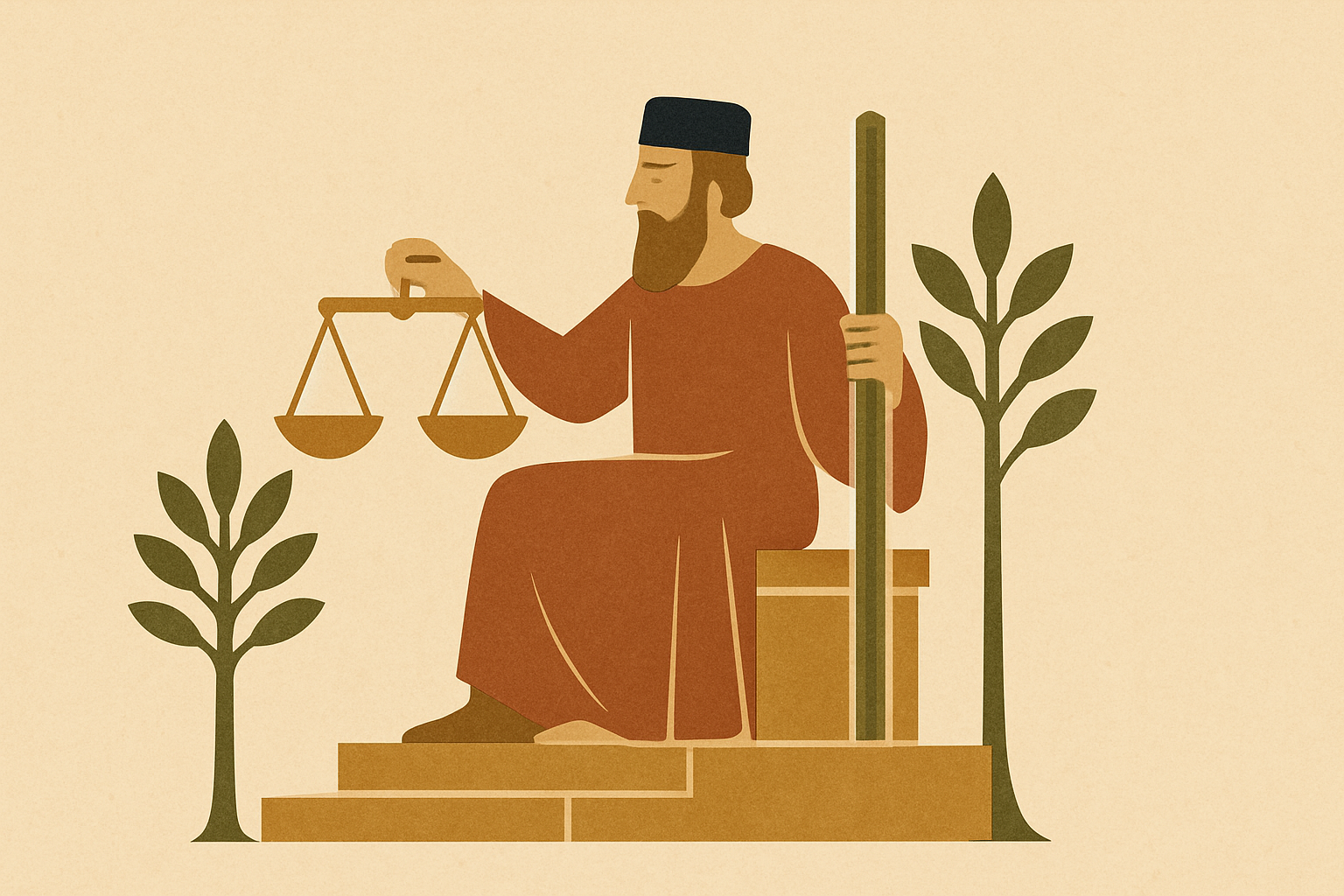
Introduction: Last week's Parasha, Re'eh, focused on the importance of following God's commandments, the centrality of the place God will choose for His worship, and the need to avoid idolatry. It also discussed the laws of kosher food, tithes, and the festivals. These themes of obedience, centralization, and holiness set the stage for this week's Parasha, Shoftim, which turns to the structure of society and the systems that will ensure justice and order in the Land of Israel.
The Parasha in Simple Words: God commands the people to appoint judges and officers in every city to ensure justice. Judges must be fair, not show favoritism, and not take bribes, because justice belongs to God. The people are told to pursue justice at all times so they can live and inherit the land. They are forbidden to plant an Asherah tree or set up a stone pillar near the altar of God, as these are forms of idolatry. Sacrificing animals with blemishes is not allowed. If someone is found worshipping other gods, after careful investigation and testimony from at least two or three witnesses, that person must be put to death by stoning. The witnesses must be the first to throw stones.
If a legal case is too difficult for the local judges, the people must go to the place God will choose and ask the priests and the judge there. Whatever they decide must be followed exactly, without turning aside. Anyone who acts arrogantly and does not listen to the judge or priest must be put to death, to remove evil from Israel.
When the people ask for a king, God allows them to appoint one, but only someone God chooses, and he must be an Israelite. The king must not have too many horses, must not send people back to Egypt to get horses, must not have too many wives, and must not accumulate too much silver and gold. The king must write a copy of the Torah for himself, read it all his life, and keep all its words, so he will not become arrogant and will not turn away from the commandments.
The priests and Levites do not get a share of the land; instead, they live off the offerings brought to God. The people must give them their first fruits, grain, wine, oil, and the first wool from their sheep. If a Levite moves to the place God chooses, he can serve there like all the other Levites and share equally in the offerings.
The people are warned not to imitate the nations by practicing sorcery, divination, witchcraft, or consulting ghosts and spirits. Anyone who does these things is detestable to God. Instead, God will raise up a prophet from among the people, like Moses, and the people must listen to him. If a prophet speaks in God's name but says something God did not command, or speaks in the name of other gods, that prophet must die. If a prophet's words do not come true, it is a sign that God did not send him.
Three cities of refuge must be set aside in the land, so that someone who kills another person accidentally can flee there and be safe. The land must be divided into three parts, and the roads to these cities must be prepared. If the land grows, three more cities must be added. If someone kills another person on purpose, he cannot use a city of refuge to escape punishment. The elders must send for him and hand him over to be put to death. The people are told not to move their neighbor's boundary marker.
In court, a single witness is not enough to convict someone of a crime; there must be at least two or three witnesses. If a witness gives false testimony, the judges must investigate carefully. If the witness is lying, he must receive the punishment he wanted for the other person. This is to remove evil from among the people and to make others afraid to do the same.
When the people go to war, the priests must encourage the soldiers not to be afraid, because God is with them. Officers must send home anyone who has built a new house and not lived in it, planted a vineyard and not enjoyed its fruit, become engaged but not married, or is simply afraid. Before attacking a city, the people must offer peace. If the city accepts, its people become workers for Israel. If it refuses, the men are killed and the women, children, and animals are taken as spoils. Cities that belong to the nations living in the land must be completely destroyed, so the Israelites will not learn their ways. Fruit trees must not be cut down during a siege; only trees that do not bear fruit can be used to build siege works.
If someone is found murdered in a field and the killer is unknown, the elders of the nearest city must measure the distance to the body, take a young cow that has never worked, and break its neck in a valley. The priests and elders must wash their hands over the cow and declare that they did not shed this blood and did not see what happened. They ask God to forgive the people and remove the guilt of innocent blood from Israel.
An Idea from the Parasha: One of the most powerful messages in this Parasha is the command, “Justice, justice you shall pursue.” This is not just a call for fair courts, but a demand that every person actively seek justice in all areas of life. The repetition of the word “justice” teaches that the process must be just as well as the outcome. It is not enough to have good intentions or to reach a fair result; the way we get there must also be honest and upright. This idea reminds us that the pursuit of justice is a lifelong mission, and that every step along the way matters. It is a call to build a society where fairness, integrity, and respect for others are at the center of everything we do.
Created by Rabbi Ari (AI)