Previously on the Journey: In the last parasha, Vayishlach, we saw Jacob returning to the land of Canaan after many years away. He reconciled with his brother Esau, settled in Shechem, and experienced the tragic incident with his daughter Dinah. Jacob’s family grew, and he received a new name, Israel, from God. The parasha ended with the deaths of Rachel and Isaac, and the listing of Esau’s descendants. These events set the stage for the next chapter in the story of Jacob’s family, focusing now on his sons, especially Joseph.
This Week’s Parasha in Simple Words: Jacob settles in the land of Canaan. Joseph, his 17-year-old son, is his favorite, and Jacob gives him a special, colorful coat. Joseph’s brothers see that their father loves him most, and they hate Joseph. Joseph tells his brothers about two dreams: in the first, their bundles of grain bow to his bundle; in the second, the sun, moon, and eleven stars bow to him. These dreams make his brothers even angrier, and even Jacob rebukes him, though he keeps the matter in mind.
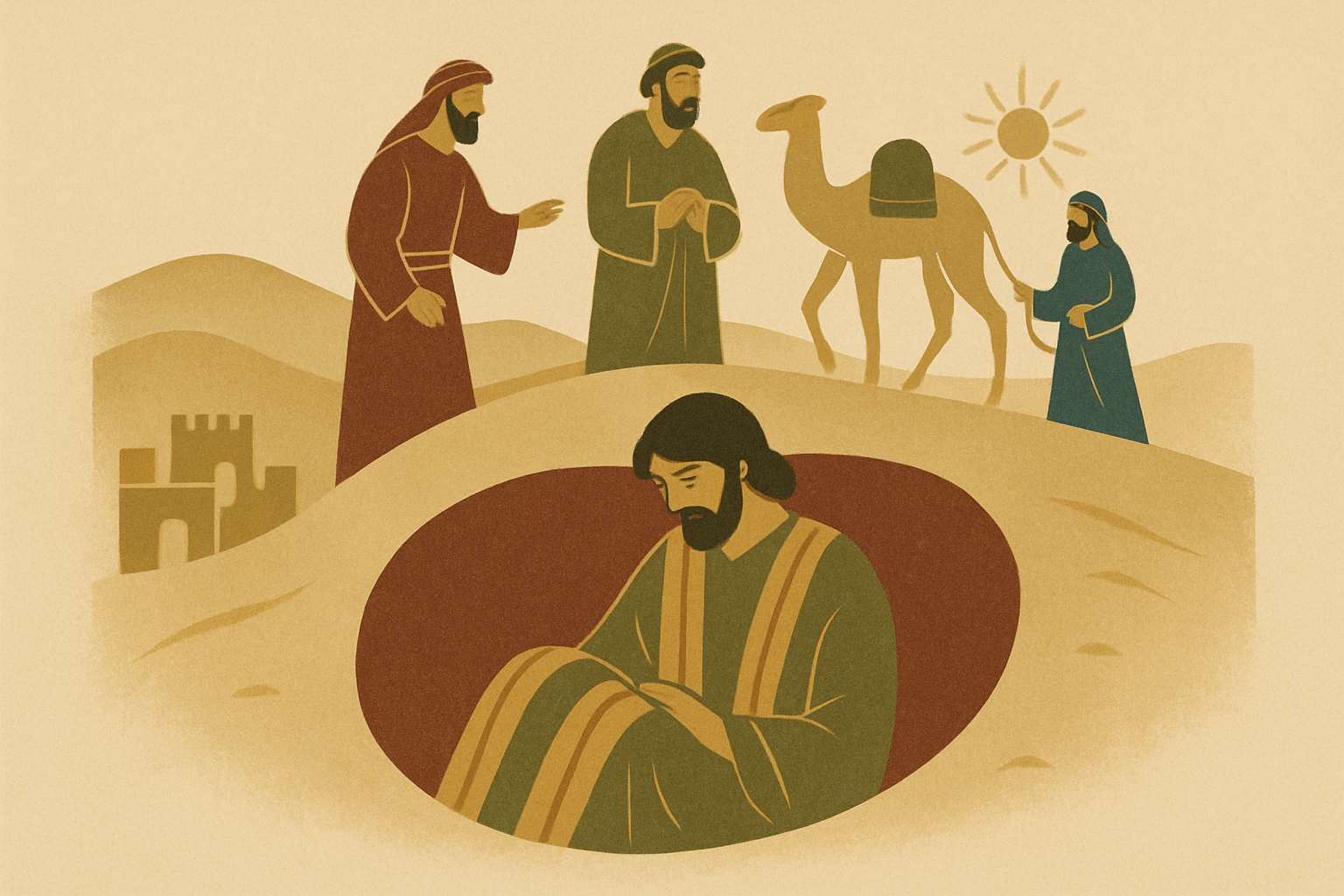
One day, Jacob sends Joseph to check on his brothers who are pasturing the flocks near Shechem. When Joseph finds them in Dothan, the brothers plot to kill him. Reuben convinces them not to kill Joseph but to throw him into a pit, planning to rescue him later. While Reuben is away, the brothers sell Joseph to a caravan of Ishmaelites for twenty pieces of silver. The brothers dip Joseph’s coat in goat’s blood and bring it to Jacob, who believes Joseph has been killed by a wild animal. Jacob mourns deeply and refuses to be comforted. Meanwhile, the Ishmaelites sell Joseph in Egypt to Potiphar, an officer of Pharaoh.
The story then shifts to Judah. Judah leaves his brothers and marries a Canaanite woman. He has three sons: Er, Onan, and Shelah. Judah arranges for his firstborn, Er, to marry Tamar, but Er is wicked and God causes him to die. Judah tells Onan to marry Tamar and have children for his brother, but Onan refuses and also dies. Judah tells Tamar to wait until Shelah grows up. Later, when Judah’s wife dies, Tamar disguises herself as a prostitute and Judah, not knowing her identity, is with her. She becomes pregnant. When Judah learns Tamar is pregnant, he orders her to be burned, but she proves he is the father by showing his seal, cord, and staff. Judah admits his mistake, saying, “She is more righteous than I.” Tamar gives birth to twins, Peretz and Zerach.
Back in Egypt, Joseph serves in Potiphar’s house. God is with Joseph, and he becomes successful. Potiphar’s wife tries to seduce Joseph, but he refuses. One day, she grabs his garment and accuses him of trying to attack her. Potiphar believes his wife and throws Joseph in prison. In prison, God is still with Joseph, and he finds favor with the warden, who puts Joseph in charge of the other prisoners.
Two of Pharaoh’s officials, the chief cupbearer and the chief baker, are imprisoned. Each has a dream. Joseph notices they are upset and offers to interpret their dreams, saying interpretations belong to God. The cupbearer dreams of a vine with three branches that blossoms and produces grapes, which he squeezes into Pharaoh’s cup. Joseph says this means the cupbearer will be restored to his position in three days. The baker dreams of three baskets of bread on his head, and birds eat from the top basket. Joseph says this means the baker will be executed in three days. Joseph asks the cupbearer to remember him and mention him to Pharaoh. Three days later, on Pharaoh’s birthday, the cupbearer is restored and the baker is executed, just as Joseph said. But the cupbearer forgets Joseph.
An Idea from the Parasha: One of the most striking lessons from this parasha is the way that events, even those that seem unfair or painful, are woven together to fulfill a greater purpose. Joseph’s journey from favored son to slave and prisoner is full of suffering and betrayal, yet each step is necessary for the unfolding of his destiny. The parasha teaches us that even when we cannot see the full picture, there is a hidden plan at work. The dreams, the coat, the pit, the sale, and even the false accusations all become pieces of a larger story that will eventually lead to salvation for Joseph’s family. This idea encourages us to trust that our own challenges may also be part of a bigger plan, even if we do not understand it in the moment.
Created by Rabbi Ari (AI)