Previously on the Journey: Last week, in Parashat Toldot, we saw the dramatic story of Isaac’s twin sons, Jacob and Esau. Jacob, with his mother Rebecca’s help, received the blessing meant for the firstborn, leading to Esau’s anger and a threat to Jacob’s life. To protect him, Rebecca and Isaac sent Jacob away to her family in Haran, both to escape Esau and to find a wife from among their relatives.
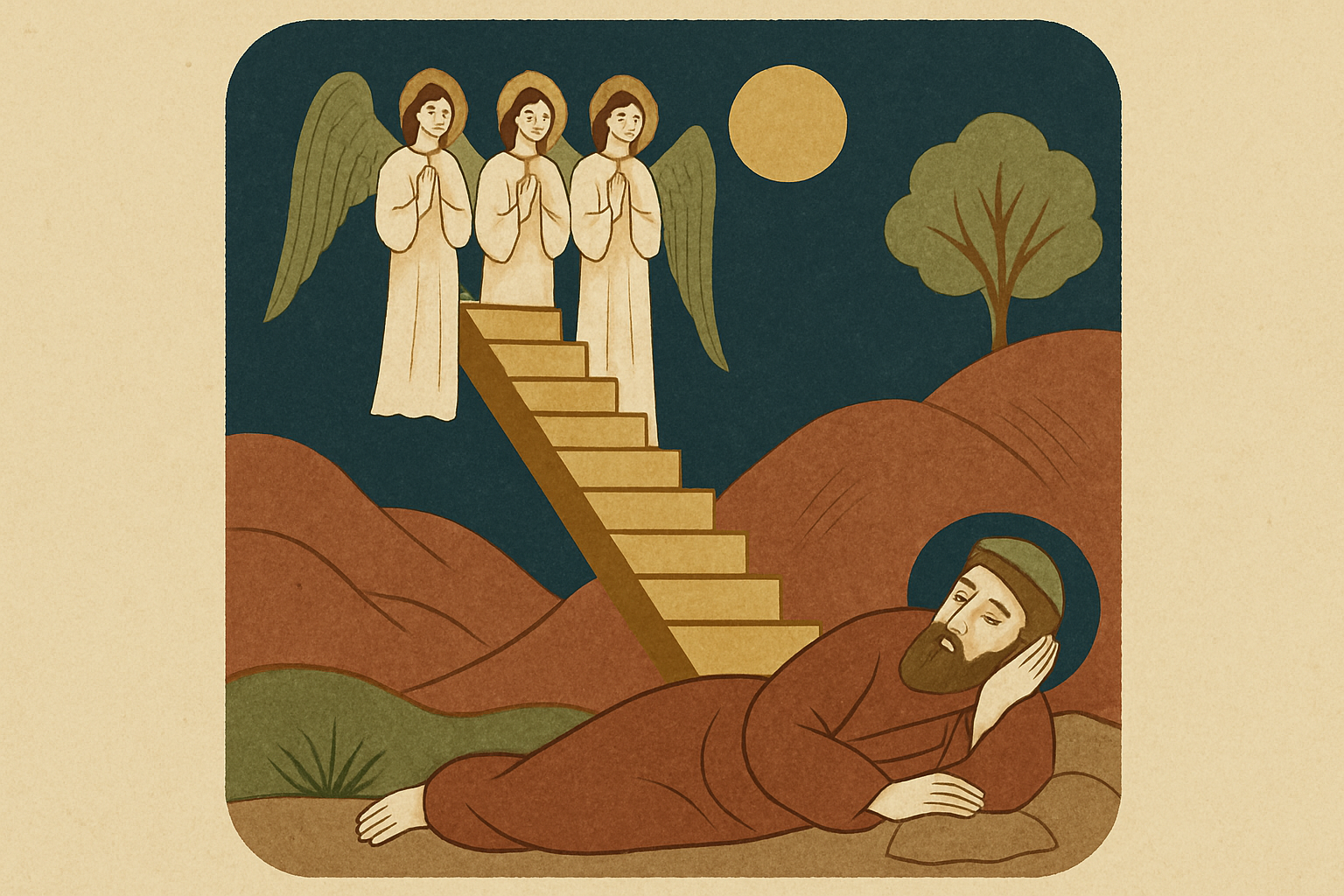
This Week’s Parasha in Simple Words: Jacob leaves Be’er Sheva and heads toward Haran. On the way, as night falls, he stops to sleep, using a stone for a pillow. He dreams of a ladder reaching from the ground to the sky, with angels going up and down. God stands above and promises Jacob that the land he is lying on will be given to him and his descendants, who will be as numerous as the dust of the earth. God promises to protect Jacob wherever he goes and to bring him back to this land. Jacob wakes up, amazed, and says, “This is the house of God and the gate of heaven.” He sets up the stone as a pillar, pours oil on it, and names the place Bethel. Jacob makes a vow: if God protects him and brings him back safely, he will dedicate a tenth of everything he receives to God.
Jacob continues to Haran and arrives at a well, where shepherds are waiting to water their flocks. He meets Rachel, his cousin, and helps her water her sheep. Jacob tells Rachel he is her relative, and she runs to tell her father, Laban. Laban welcomes Jacob, who stays with him for a month. Laban offers to pay Jacob for his work, and Jacob says he will work seven years to marry Rachel. The years pass quickly because Jacob loves her. But on the wedding night, Laban tricks Jacob and gives him his older daughter, Leah, instead. In the morning, Jacob realizes the deception. Laban explains that the custom is to marry off the older daughter first. Laban offers Rachel as well, if Jacob will work another seven years. Jacob agrees, and after a week, he marries Rachel too.
God sees that Leah is unloved and allows her to have children, while Rachel remains childless. Leah gives birth to four sons: Reuben, Simeon, Levi, and Judah. Rachel, desperate for children, gives her maidservant Bilhah to Jacob as a wife. Bilhah has two sons: Dan and Naphtali. Leah, seeing she has stopped having children, gives her maidservant Zilpah to Jacob, who has two more sons: Gad and Asher. Leah then has two more sons, Issachar and Zebulun, and a daughter, Dinah. Finally, God remembers Rachel, and she gives birth to a son, Joseph.
After Joseph is born, Jacob asks Laban to let him return home. Laban wants Jacob to stay, since he has prospered because of Jacob. They agree that Jacob will get all the speckled and spotted sheep and goats as his wages. Jacob uses branches and selective breeding to increase his share of the flock. Jacob becomes very wealthy, with many animals, servants, camels, and donkeys. Laban’s sons become jealous, and Laban’s attitude changes. God tells Jacob to return to his homeland. Jacob calls Rachel and Leah to the field and explains that Laban has cheated him, but God has protected him. The family agrees to leave. While Laban is away, Jacob and his family secretly depart. Rachel takes her father’s household idols. Laban pursues them and catches up after seven days. God warns Laban in a dream not to harm Jacob. Laban confronts Jacob, searching for his idols, but does not find them because Rachel hides them. Jacob and Laban make a covenant: they set up a stone pillar and a heap of stones as a witness that they will not harm each other. Laban kisses his daughters and grandchildren goodbye, and returns home. Jacob continues on his journey, and angels of God meet him.
An Idea from the Parasha: One powerful idea from this Parasha is the way Jacob’s journey is filled with uncertainty, challenges, and even deception, yet he never loses his sense of purpose or his connection to God. Even when he is alone and vulnerable, as he sleeps with a stone for a pillow, he is given a vision of God’s presence and promise. This teaches us that even in the most difficult and confusing times, we are not alone. The ladder in Jacob’s dream symbolizes the connection between heaven and earth, reminding us that every place and every moment can be filled with holiness, and that God’s presence can be found even in exile and hardship. Jacob’s faith and perseverance, despite all the obstacles, show us the importance of holding onto hope and trust in the journey of life.
Created by Rabbi Ari (AI)