Previously, in Parashat Vayetze: Yaakov (Jacob) had fled from his brother Esav (Esau) after taking his blessing. He spent twenty years in the house of Lavan, marrying Leah, Rachel, Bilhah, and Zilpah, and fathering eleven sons and a daughter. After years of hard work and growing his family and wealth, God told Yaakov to return to the land of Canaan. As Yaakov left, Lavan chased after him, but they made a peace agreement. Now, Yaakov is on his way home, but he knows he must face Esav, the brother he deceived so many years ago.
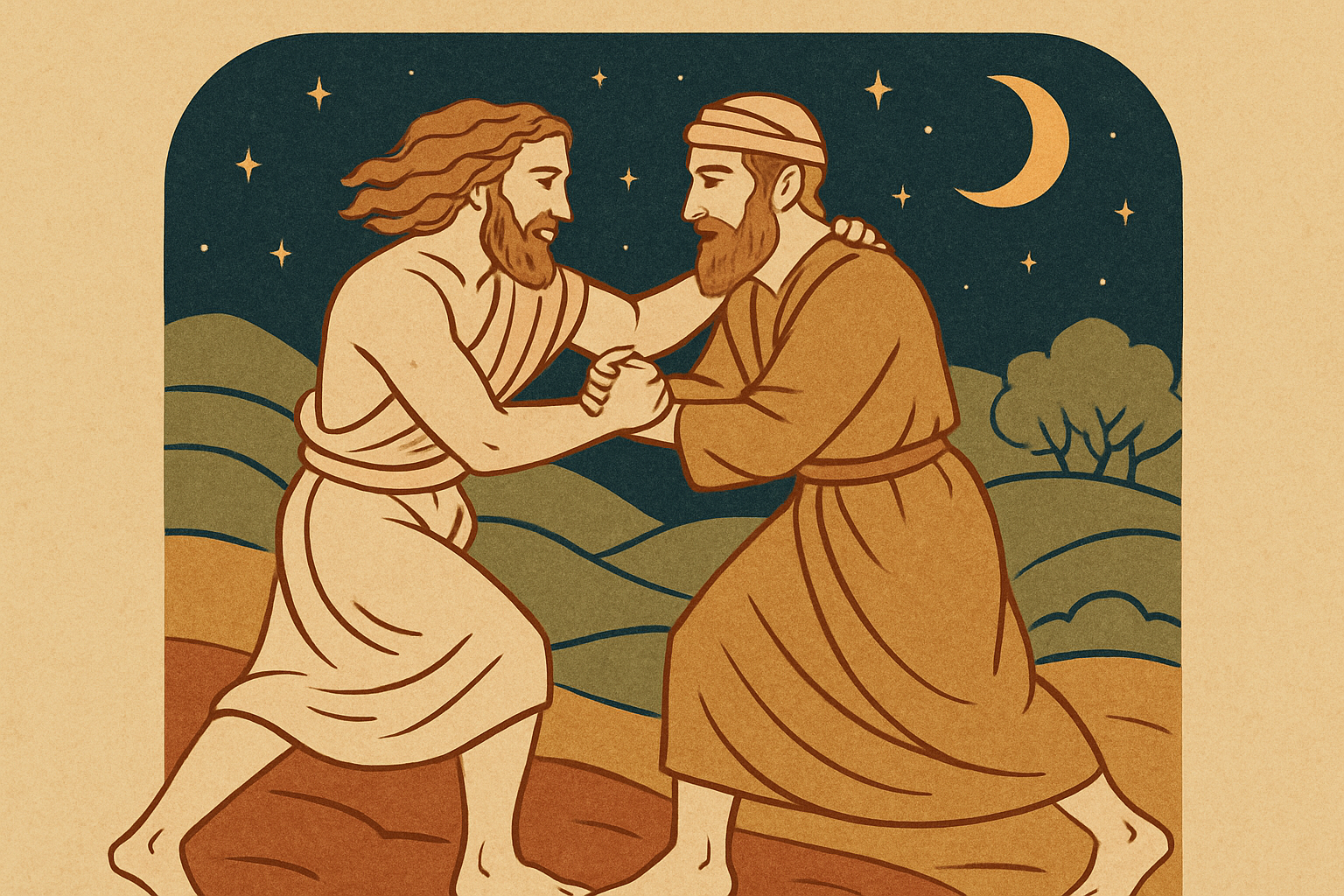
This week's Parasha, Va'yishlah, in simple words: Yaakov sends messengers ahead to Esav, who is coming to meet him with four hundred men. Yaakov is afraid and divides his family and possessions into two camps, hoping that if one is attacked, the other can escape. He prays to God for protection and sends Esav gifts of livestock to try to appease him. That night, Yaakov takes his family across the river Yabok. Left alone, Yaakov wrestles with a mysterious man until dawn. The man injures Yaakov's hip but blesses him, giving him the new name Yisrael (Israel), because he struggled with God and people and prevailed. Yaakov limps away from the encounter. The Torah then commands that the Israelites must not eat the sciatic nerve (gid hanasheh) of animals, because of Yaakov's injury.
Yaakov sees Esav approaching and bows to him seven times. Esav runs to Yaakov, hugs him, and they both weep. Yaakov introduces his family. Esav at first refuses Yaakov's gifts, but Yaakov insists, and Esav accepts. Esav offers to travel together, but Yaakov declines, saying his children and animals need to go slowly. Esav returns to Seir, and Yaakov travels to Sukkot and then to Shechem, where he buys land and sets up an altar.
In Shechem, Dinah, Yaakov's daughter, goes out to visit the women of the land. Shechem, the son of the local prince, takes her and lies with her. He then wants to marry her and asks his father, Chamor, to arrange it. Yaakov's sons are angry. Chamor and Shechem ask Yaakov and his sons to agree to intermarriage and shared land, offering to circumcise all their men. Yaakov's sons say they will agree if all the men of the city are circumcised. On the third day after the circumcision, when the men are in pain, Shimon and Levi, Dinah's brothers, attack the city, kill all the men, rescue Dinah, and take the city's wealth. Yaakov is upset, fearing the neighboring peoples will attack his family, but his sons say they could not let their sister be treated like a prostitute.
God tells Yaakov to go to Beit El and build an altar. Yaakov tells his household to get rid of foreign gods, purifies his family, and they travel safely to Beit El. God appears to Yaakov, blesses him, and confirms his new name, Yisrael. God promises him that nations and kings will come from him, and the land will be given to his descendants. Yaakov sets up a stone pillar and pours oil on it.
As they travel from Beit El, Rachel goes into difficult labor and gives birth to Binyamin (Benjamin), Yaakov's twelfth son. Rachel dies in childbirth and is buried on the way to Efrat, which is Beit Lechem (Bethlehem). Yaakov sets up a pillar on her grave. Reuven, Yaakov's eldest son, sleeps with Bilhah, his father's concubine, and Yaakov hears about it.
The Torah lists the twelve sons of Yaakov, who were born in Padan Aram. Yaakov visits his father Yitzchak (Isaac) in Chevron. Yitzchak dies at the age of 180, and his sons Esav and Yaakov bury him. The Parasha ends with a detailed list of Esav's descendants, the chiefs of Edom, and the kings who ruled in Edom before there were kings in Israel.
An idea from the Parasha: One of the most powerful moments in this Parasha is the reunion between Yaakov and Esav. After years of fear and guilt, Yaakov prepares for the worst, but Esav surprises him with a hug and tears. This teaches us that even deep wounds and old conflicts can be healed. Sometimes, the act of reaching out, showing humility, and seeking forgiveness can transform a relationship. The Parasha reminds us that people are capable of change, and that reconciliation is possible, even after years of separation and pain. The courage to face the past and the willingness to forgive can open the door to a new future.
Created by Rabbi Ari (AI)