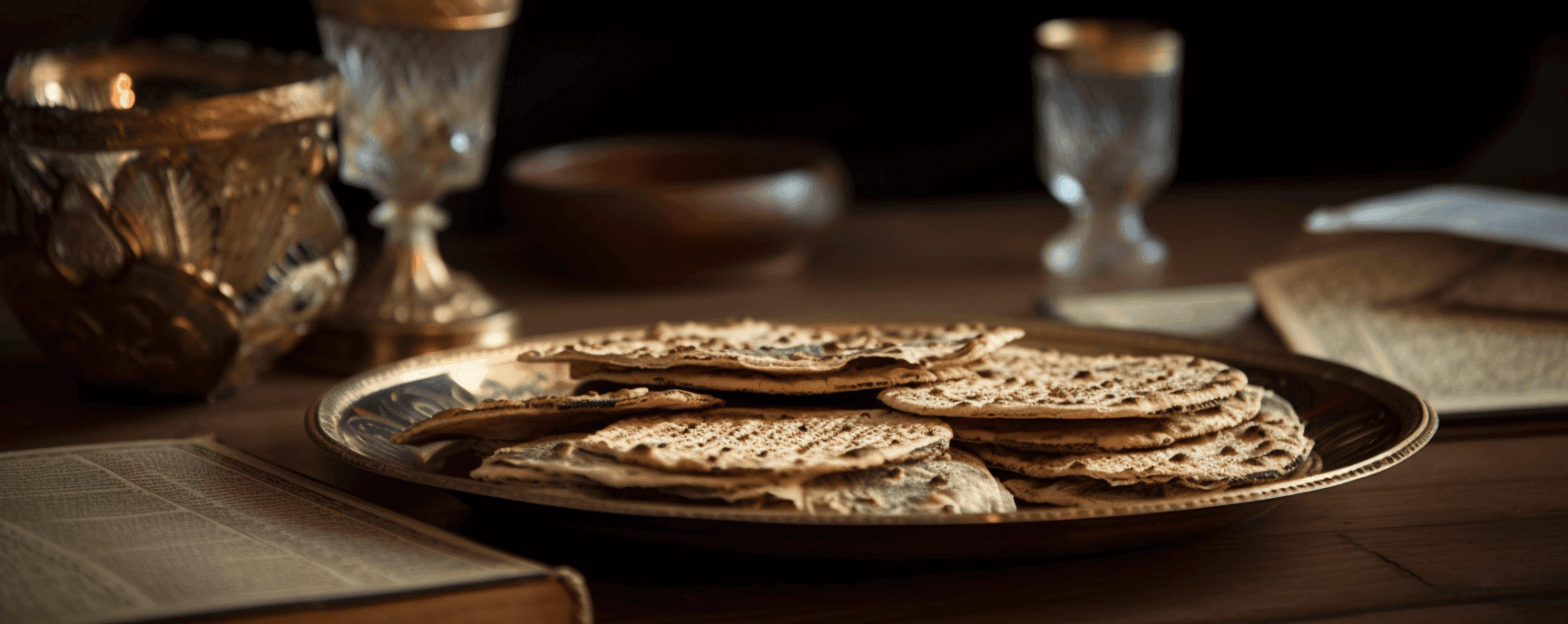
Passover begins on the eve 15th day of the Hebrew month of Nisan. Following the evening prayer service, families and friends come together for the Seder, which is one of the most significant ceremonial meals in the Jewish calendar and the most-observed ritual by Jews across the globe today. The Seder is a lengthy process that can take up many hours and last late into the night.
Once seated, the Jews follow the procedure of the Haggadah, which contains Jewish texts and provides instructions that is used as a guidebook during the Passover Seder. The stories told in the Haggadah surround the Jewish exodus from Egypt, and anecdotes and parables of the Passover tradition.
The Haggadah is divided into twelve parts:
Kadesh: The Seder begins with the recitation of the Kiddush, a blessing over a cup of wine (the first cup), to sanctify the holiday and the meal.
Urchatz: Participants wash their hands as a symbolic gesture of purification.
Karpas: A vegetable, typically parsley or celery, is dipped in saltwater and eaten to symbolize the tears shed by the Jewish people in slavery.
Yachatz: A piece of matzah is broken and half of it is set aside to be eaten later as the afikoman.
Maggid: The story of the Jewish exodus from Egypt is retold, including the Ten Plagues, the departure from Egypt, and the parting of the Red Sea. The Four Questions are asked, and the Four Sons are discussed, each representing a different type of child and their question. At the end of Maggid, participants drink the second cup of wine or grape juice.
Rachtzah: The hands are washed again, this time in preparation for eating the matzah.
Motzi Matzah: The blessing over the matzah is recited, and then participants eat the matzah.
Maror: A bitter herb, typically horseradish, is eaten to symbolize the bitterness of slavery.
Korech: A sandwich of matzah, bitter herbs, and charoset (a mixture of chopped apples, nuts, and wine) is eaten to symbolize the mortar that the Jewish slaves used to build buildings in Egypt.
Shulchan Orech: The festive meal is served, including traditional Passover foods such as brisket, chicken, and matzah ball soup.
Tzafun: The afikoman, the piece of matzah set aside earlier, is found and eaten, symbolizing the Paschal sacrifice and the redemption of the Jewish people.
Barech: The Birkat Hamazon, the blessing after the meal, is recited, at the end of which a third cup is drunk.
Hallel: Psalms of praise are recited, followed by the recitation of the Great Hallel, concluding with a fourth cup of wine or grape juice.
Nirtzah: The Seder concludes with a prayer that God accept the Seder and the Passover holiday.
The Seder is marked by its interactive nature – all attendants are invited to participate – and its special rituals. The four cups of wine each hold its own symbolic meaning:
1. The first cup, known as the Kiddush cup, is used to sanctify the holiday and the meal, and to express gratitude for the blessings of the season.
2. The second cup is drunk after the telling of the story of the exodus from Egypt, to remind participants of God's promise to free the Jewish people from slavery.
3. The third cup is drunk after the Birkat Hamazon, the blessing after the meal, and is known as the Cup of Redemption, symbolizing the redemption of the Jewish people from slavery.
4. The fourth cup is drunk after the conclusion of the Hallel prayer, and is known as the Cup of Acceptance, symbolizing the Jewish people's acceptance of God's covenant and their commitment to following His laws.
Some interpretations hold that the four cups also correspond to the four stages of redemption mentioned in the Torah: "I will bring you out," "I will deliver you," "I will redeem you," and "I will take you to be My people." By drinking these four cups, participants affirm their belief in the divine plan of redemption and their commitment to living in accordance with God's will.
Another significant moment is the recitation of the Four Questions, usually spoken or sung out loud by children, designed to spark curiosity and prompt discussion about the meaning and symbolism of the Passover holiday.
The Four Questions are as follows:
1. "Why is this night different from all other nights?" – This question serves as an introduction to the Seder and highlights the uniqueness of the Passover holiday.
2. "Why do we eat unleavened bread (matzah) instead of regular bread?" – This question prompts discussion of the historical reason why the Jewish people ate matzah during their hasty departure from Egypt.
3. "Why do we eat bitter herbs (maror)?" – This question invites reflection on the bitterness of slavery and the hardships that the Jewish people endured.
4. "Why do we dip vegetables twice (karpas)?" – This question prompts discussion of the symbolism behind the dipping of vegetables in saltwater, which represents the tears shed during slavery.
By asking these questions and engaging in discussion about the answers, participants deepen their understanding of the Passover holiday and its significance in Jewish history and tradition.
The Seder in its entirety is perhaps best summarized by the opening statement recited by the leader of the Seder: "Ha Lachma Anya" (הא לחמא עניא) is a Hebrew Aramaic phrase that means "This is the bread of affliction." This statement refers to the matzah, or unleavened bread. Matzah is called "the bread of affliction" because it represents the haste with which the Jewish people had to leave Egypt, without sufficient time to let their bread rise. The Ha Lachma Anya statement continues with an invitation to those in need to join in the Passover celebration: "Let all who are hungry come and eat, let all who are in need come and celebrate Passover with us." This reflects the spirit of hospitality and inclusivity that is central to the Passover holiday, as well as the Jewish value of helping those in need. Passover celebrates the freedom of the Jewish people by commemorating its time as an enslaved people.